
Border Games
Who benefits from a crisis in Ceuta?

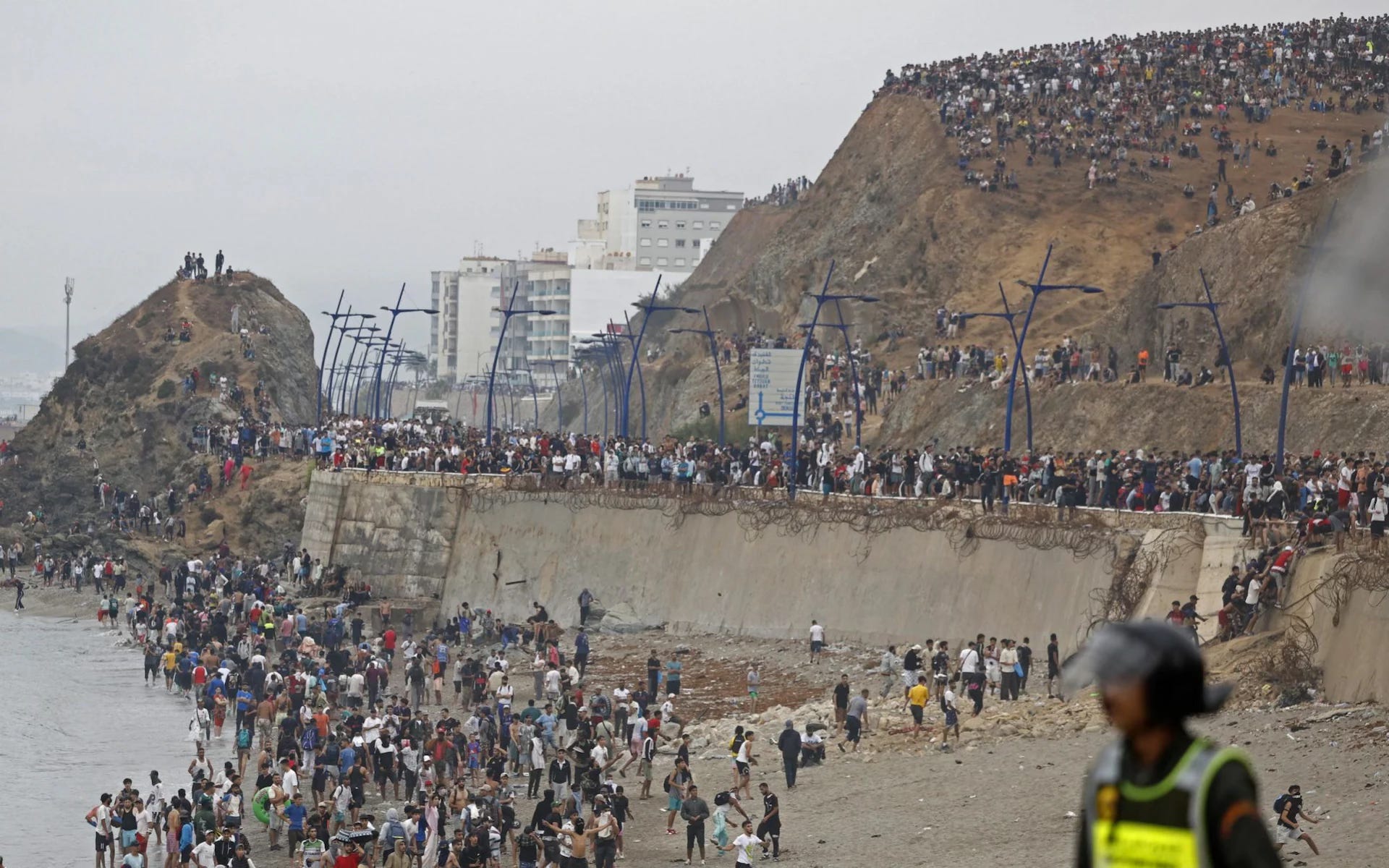
Last week, an estimated 60,000 migrants crossed into the Spanish enclave of Ceuta—a small territory on the North African coast physically sharing a border with Morocco. While many arrived via sea, a significant number also breached the border by land. If accurate, this figure would mark the largest single immigrant arrival ever recorded on European Union territory. Reports indicate that the unprecedented scale of the crossing may have been influenced by external factors, with multiple sources suggesting the participants were actively encouraged.
Regardless of whether the event was orchestrated, it begs the question: whose geopolitical interests are served when Ceuta becomes a flashpoint?
In March, Spain blocked the United States from using the jointly operated military bases at Rota and Morón on its territory for strikes against Iran, as Madrid ramped up its condemnation of what it termed an “unjustified and dangerous military intervention.” Socialist Prime Minister Pedro Sánchez explicitly denounced the “unilateral military action” launched by the US and Israel against Iran, issuing a warning that it is driving the international order towards a far more hostile and uncertain future.
As a result, relations between the U.S. and Spain have hit a historic low, with Trump regularly adopting a threatening tone toward Spain in interviews. A month ago, Trump piled on the pressure during a speech:
“Ah, the Spanish. They're members of NATO, but not very good members of NATO. They say, "No, we don't want to help other people." What are we doing, huh? They are not behaving nicely.
They were learned soon after they relinquished their grip on Cuba and Guam, the Philippines, and Puerto Rico, and they were all ours. And speaking of Cuba, after many many decades, it’s coming our way.”
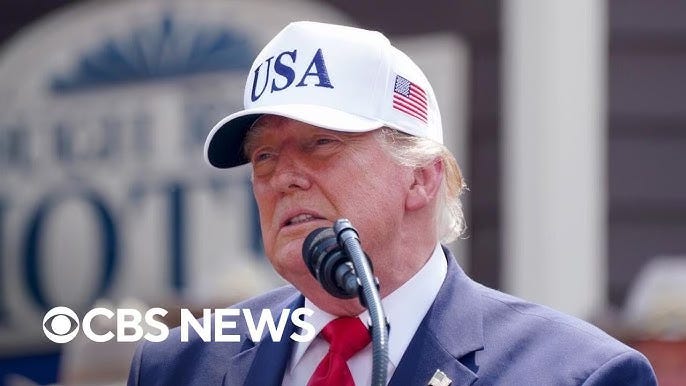
Given this week’s events in Ceuta, what stands out in hindsight is Trump’s choice to invoke those very historical losses during that speech. Reminding Spain how Cuba, Guam, Puerto Rico, and the Philippines were once ceded to the U.S.
Against this backdrop of deteriorating diplomatic relations, shifts were already taking place within Washington policy circles.
Earlier this year, heavy lobbying targeting the Trump administration—and Secretary of State Marco Rubio in particular—began to draw attention to Spain's North African territories. The intellectual groundwork was laid by the American Enterprise Institute, a prominent Washington-based public policy think tank, which published an article in March outlining how Morocco could theoretically pressure or retake the Spanish enclaves without facing international consequences:
“Moroccans should gather, send bulldozers to the border, and then enter Ceuta and Melilla unarmed to raise the flag. Sánchez and the Spanish press bleat, but they have no grounds to act. Nor, for that matter, would NATO, even if Moroccan forces entered the towns to restore order and organize the dispatch of settlers across the Strait of Gibraltar and back to Spain.
Neither Ceuta, Melilla, nor the Canary Islands would trigger a NATO response, just as NATO would not need to respond to an attack on Hawaii or Puerto Rico.”
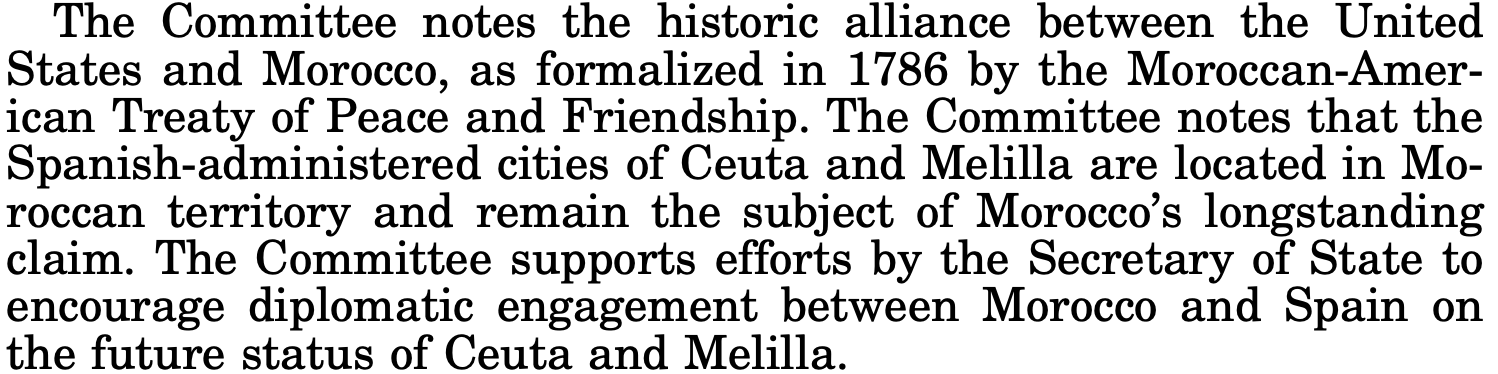
Subsequently, what began as a proposal within policy and research circles soon found its way into official legislative channels. Just a month later, the U.S. House of Representatives published House Report 119-1631, declaring the Spanish cities of Ceuta and Melilla to be located in “Moroccan territory.” This marked the first time a body of the U.S. Congress has cast written doubt on Spanish sovereignty over the two North African enclaves. The author of the report was Congressman Mario Díaz-Balart, who himself called Marco Rubio a “dear and close friend”.
Ultimately, these are extraordinary reports to read in light of what happened this week. While these publications do not prove that foreign governments directly coordinated the border push, they demonstrate that prominent figures have openly signaled a willingness to write off Spanish sovereignty. Thus creating a high-stakes geopolitical backdrop.
Sources point to local dynamics—including online mobilization, domestic political rivalries in Morocco, and criminal networks—that played an immediate role on the ground. However, this crisis cannot be viewed in isolation from the struggle over a strategic piece of land in Africa and the broader geopolitical landscape playing out across the region.
For instance, the Spanish enclaves in North Africa, and Ceuta in particular, occupy extremely strategic locations. By holding Ceuta, Spain—and, by extension, its European allies—controls a strategic point along the Strait of Gibraltar, ensuring that this vital shipping lane cannot be easily shut down, unlike the Strait of Hormuz.
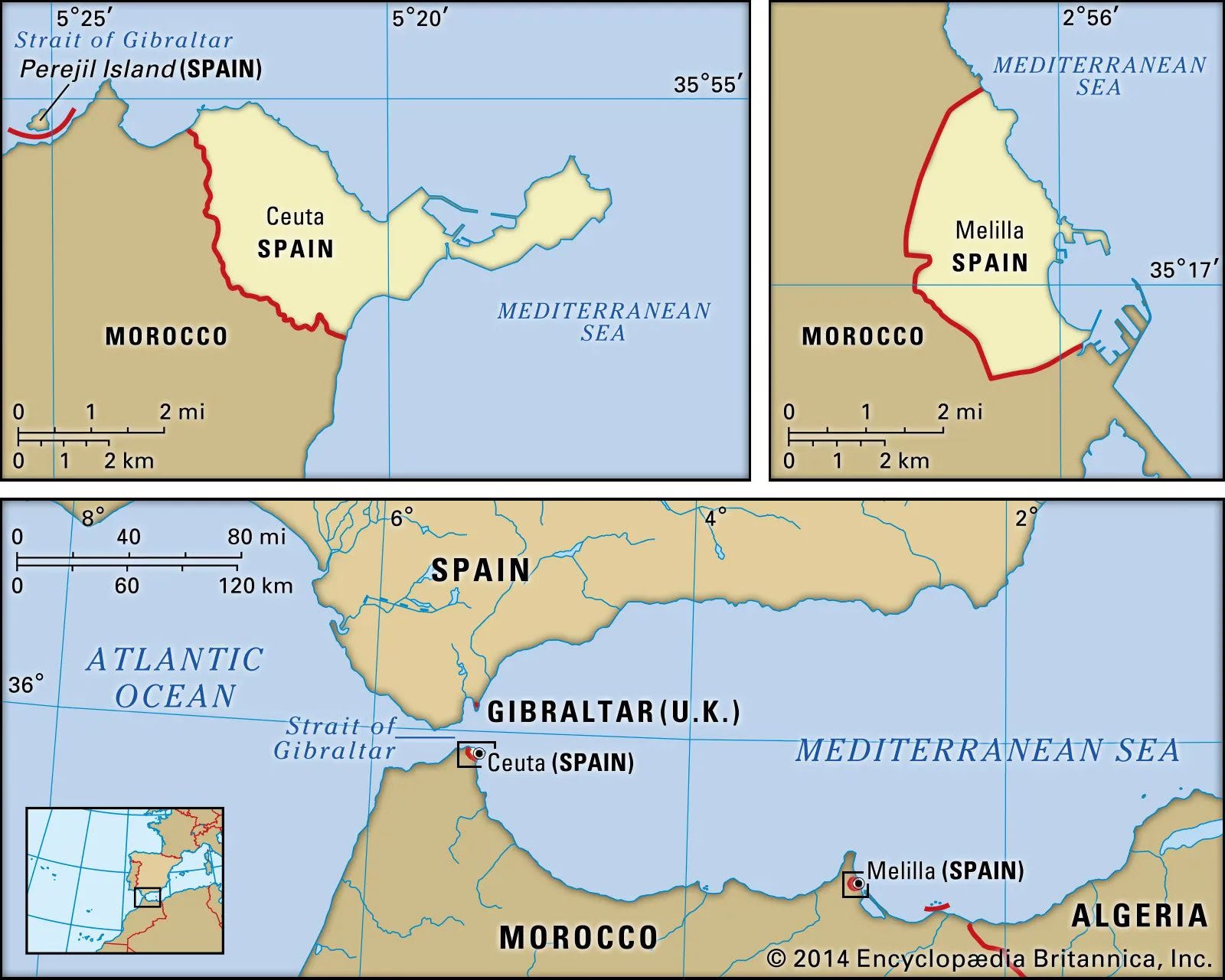
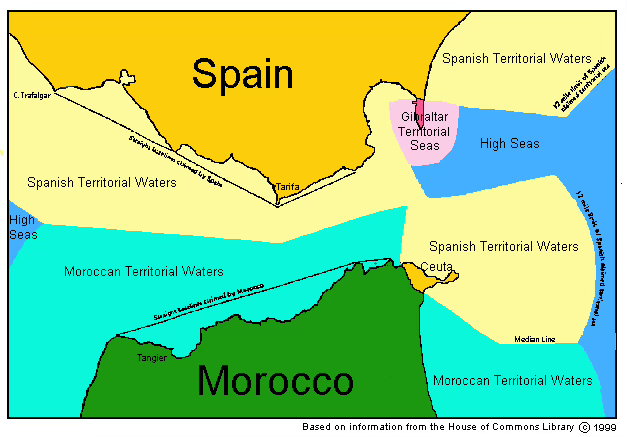
When looking at the map of maritime boundaries, such as the territorial waters around the Strait of Gibraltar, Spain and Morocco—it becomes instantly clear how complex and fiercely contested this geographic choke point is.
Both Spain and Morocco claim overlapping maritime zones and 12-mile territorial limits governed by international law. However, maps like these visualize more than just lines in the water; they map out a profound geopolitical tug-of-war. Control over enclaves like Ceuta and Melilla on the African coast, combined with European territories like Gibraltar, create a complex web of maritime jurisdiction that allows nations to project power, regulate naval traffic, and tightly manage one of the most vital shipping lanes in global trade.
This is where Israel enters the equation, bringing an entirely new layer of leverage to the geopolitical board. To understand this dynamic, one must look back to the normalization of ties between Israel and Morocco under the Abraham Accords in 2020. Morocco entered into this partnership primarily to secure United States recognition of its sovereignty over the disputed Western Sahara territory, gaining vital military and intelligence upgrades as well as a critical diplomatic shield. This fundamentally transformed Rabat into a major strategic node backed by Washington.
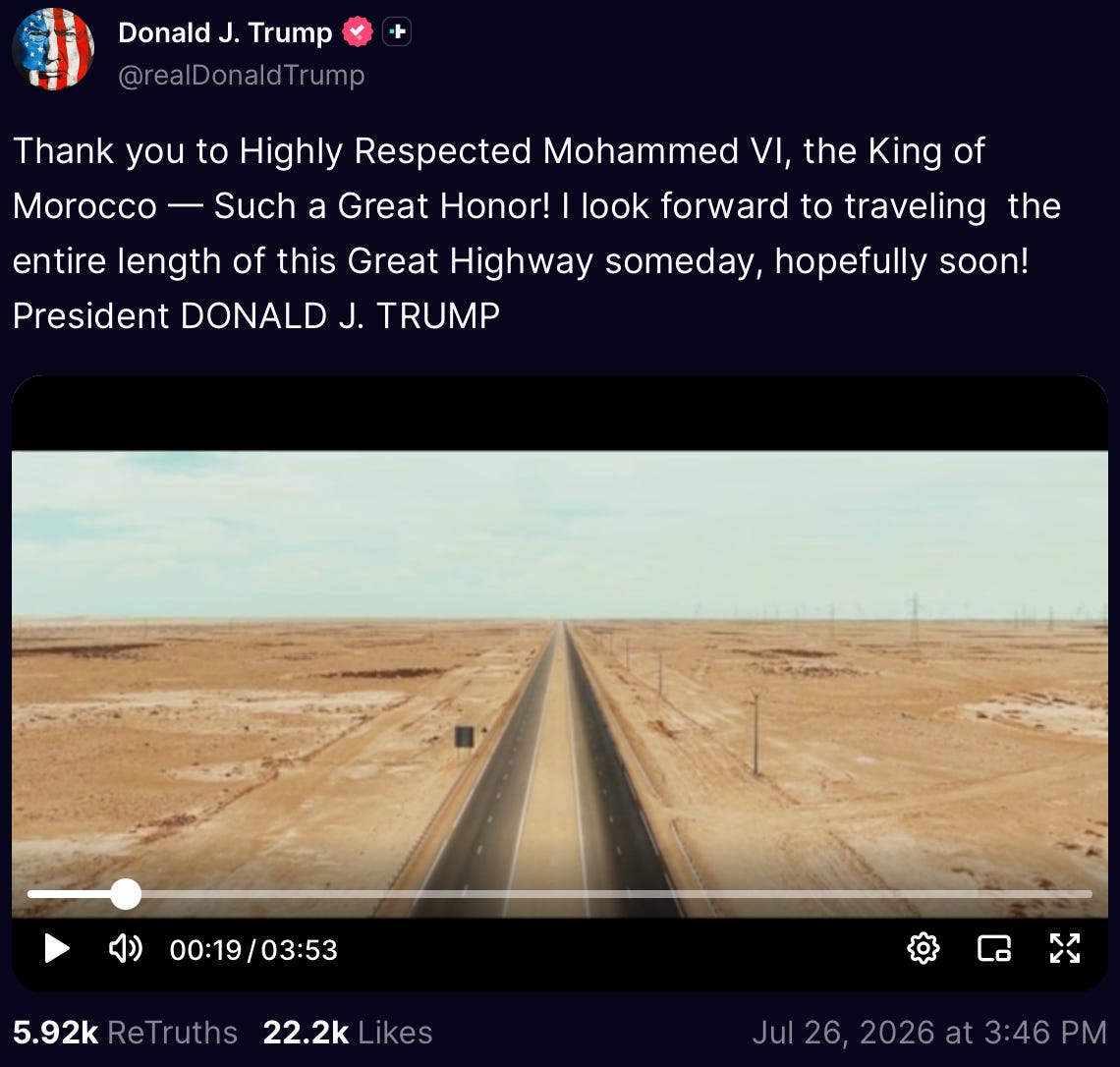
Furthermore, the transactional nature of this partnership is vividly visible on the ground through mega-projects like the $1 billion Tiznit–Dakhla expressway, reportedly dubbed the "President Donald J. Trump Highway." Stretching deep into the disputed territory, such infrastructure projects physically and symbolically cement the axis between Washington and Rabat, illustrating why Morocco feels uniquely emboldened in the region.
Building on this strategic alliance, commentators in Israeli outlets like Ynetnews explicitly argued earlier this year that Israel could use its diplomatic weight and influence in Washington to support Morocco’s territorial claims over Ceuta and Melilla as a tool to pressure and punish Spain.
In addition, this leverage became particularly relevant as relations between Madrid and Tel Aviv sharply deteriorated—driven by Spain’s recognition of Palestine in 2024, its criticism of Israeli military operations in Gaza, Lebanon, and Iran, and its push for EU sanctions against Israel.
This alignment quickly spilled over into public diplomacy. High-profile friction erupted when Israel’s UN Ambassador Danny Danon publicly called out Spain over the Ceuta crisis:
“Spain, which never misses an opportunity to lecture Israel, has declared a state of emergency in Ceuta following the crisis over its immigration policy.
Maybe before it continues lecturing us, it’s time it explained to the world why it still maintains colonial enclaves in Africa.”
In response, Spanish Minister Óscar Puente shared the post on X, noting that things were “becoming quite clear.” His comments feed the intense speculation across Spanish media and political circles that Israel, Morocco, and the U.S. are tightly coordinated in an effort to apply intense pressure on Prime Minister Pedro Sánchez’s progressive government.
Beyond the geopolitical maneuvering, the crisis has exposed Europe’s ultimate Achilles’ heel: irregular migration as a permanent fracture line within the bloc. Rather than uniting the European Union in solidarity, the shockwaves of the Ceuta crossing have immediately fueled internal division. Demonstrating how quickly external pressure can shatter European cohesion, Italy moved to temporarily suspend the EU’s passport-free Schengen agreement with Spain, triggering an immediate diplomatic row and forcing emergency talks among member states.
Whether the events in Ceuta were the result of a coordinated push or an opportunistic spark ignited by immigrants looking for a better life, one thing is clear: the crisis did not happen in a vacuum. Long-standing tensions in the region have only deepened. In a shifting international order, Ceuta is no longer just a local border crossing. Rather, it has become a high-stakes geopolitical lever, a vulnerability that multiple global actors, each with their own interests, are all too willing to exploit.
As pressure on the southern border grows, Europe may soon find that the true battle for its stability is being fought at its most contested geographical choke points.
Thank you for reading!
If you enjoy connecting the dots behind the headlines, subscribe for free. New pieces land straight in your inbox.
📨 If you think someone would enjoy this, send it their way!
Great overview on the migrants phenomenon, in Ceuta and Melilla.
On the role of Israel, one should add Itamar Ben Gvir comment on X: "My congratulations to the President of the Government of Spain, Pedro Sánchez, for his profound commitment to welcoming immigration and "human diversity". (...) open the doors of Spain and grant refuge to the residents of Gaza who seek to emigrate. This is an excellent opportunity to contribute a little more to Spain's "human diversity".
I am still amazed they keep holding on to these exclaves, they're just problems ever since immigration went front and center - I am not sure the "pros" as you laid them out perfectly (maritime law zoning) outweigh the cons... and as you say this might just be the goal here.
Those exclaves can be - and it seems will be - weaponized, as we've now seen yet again. Spain should seriously consider the implications or risk Schengen.
Everyone should focus on the who and how of this weekend's happenings and ask themselves "what for". If you have seen some of the live reporting I am seriously asking who lives in Ceuta and thinks "that was the best decision of my life"?