
Licensed Force
The United States is reviving the model of the chartered company

In 1753, the Dutch Republic attempted something that would feel familiar today: projecting power in the Persian Gulf through commercial actors.
The Dutch East India Company (The VOC), established a fortified presence on the island of Kharg, then known as Kareem, off the Iranian coast. It was not a formal wing of the state navy, nor was it a sovereign kingdom. Yet, it possessed the authority to build defenses, arm ships, negotiate with local emirs, and project lethal force in pursuit of commercial advantage. Shareholders in Amsterdam supplied the capital, while cannons and contracts supplied the authority.
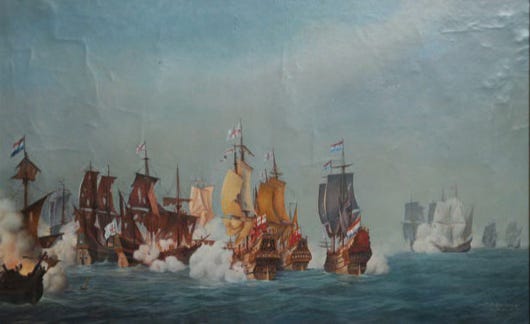
Today, roughly 270 years later, the world is witnessing a modernized return of this model. The confrontation involving Iran, and the broader struggle for global hegemony, suggest the opening phase of a post-state system of conflict.
At the forefront of this transformation stands Palantir Technologies. The company’s name is a direct reference to the Palantíri from J.R.R. Tolkien’s The Lord of the Rings: indestructible ‘seeing stones’ that allowed rulers to communicate across vast distances and observe events hidden from the ordinary eye. Palantir’s recent twenty-two-point manifesto marks the end of the state’s monopoly on conflict and the rise of a new era in which coporations increasingly shape the instruments of war.

The Palantir manifesto represents an ideological rupture with the Silicon Valley consensus that has dominated the last thirty years. For decades, technology firms operated under the guise of borderless idealism, prioritizing global market expansion over national loyalty. Alex Karp’s declaration of a “moral debt” signifies the death of that illusion, explicitly binding the fate of the corporation to the strength of the nation-state:
“Silicon Valley owes a moral debt to the country that made its rise possible. The engineering elite of Silicon Valley has an affirmative obligation to participate in the defense of the nation.”
Much like the VOC’s Heeren XVII, who dictated the fate of distant territories from their boardrooms in the Netherlands, Palantir’s leadership has positioned the corporation as the indispensable vanguard of Western interests. The manifesto argues that the survival of democracy is no longer a matter for diplomats alone but is contingent upon technological superiority. It asserts that software is the new naval architecture—the primary instrument of power projection in the modern age:
“The limits of soft power, of soaring rhetoric alone, have been exposed. The ability of free and democratic societies to prevail requires something more than moral appeal. It requires hard power, and hard power in this century will be built on software.”
This synthesis of corporate and state power reached its symbolic zenith in April, when the President of the United States explicitly endorsed Palantir via his social media platform Truth Social, specifically citing its stock ticker.
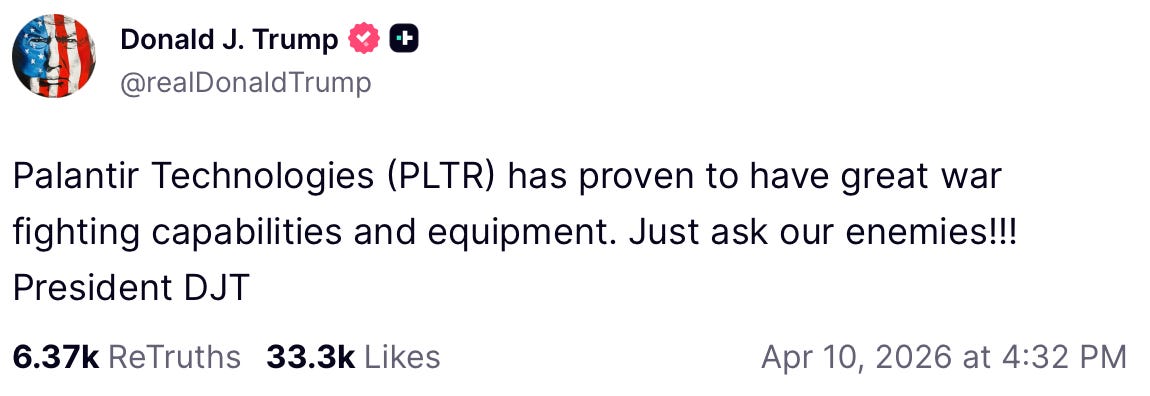
This was more than a recommendation; it was a digital Charter of 1602 for the 21st century. By tethering the company's "war fighting capabilities" to its identity as a publicly traded entity, the state effectively signaled that the defense of the West is now an investable asset. Palantir’s power is tied to its market capitalization because high valuation functions as a modern war chest. It allows the firm to bypass slow-moving government budget cycles, acquiring talent and technology at a speed that traditional military bureaucracies cannot match.
When the President invokes the ticker, he ensures that the interests of the global capital class are perfectly aligned with the kinetic goals of the military, much as the Dutch burghers of the 18th century saw no distinction between the prosperity of their portfolio and the projection of the Republic’s cannons in the Persian Gulf.
The historical stock chart of the VOC illustrates the true strength of this model: when a private company manages vital national infrastructure, market capitalization becomes a form of sovereign power. At its peak, the VOC’s wealth eclipsed the top twenty tech giants of today combined. By overlaying this trajectory onto the rise of Palantir, we see how an astronomical valuation acts as a shield, allowing a corporation to innovate and take risks at a pace no democratically accountable government can match.
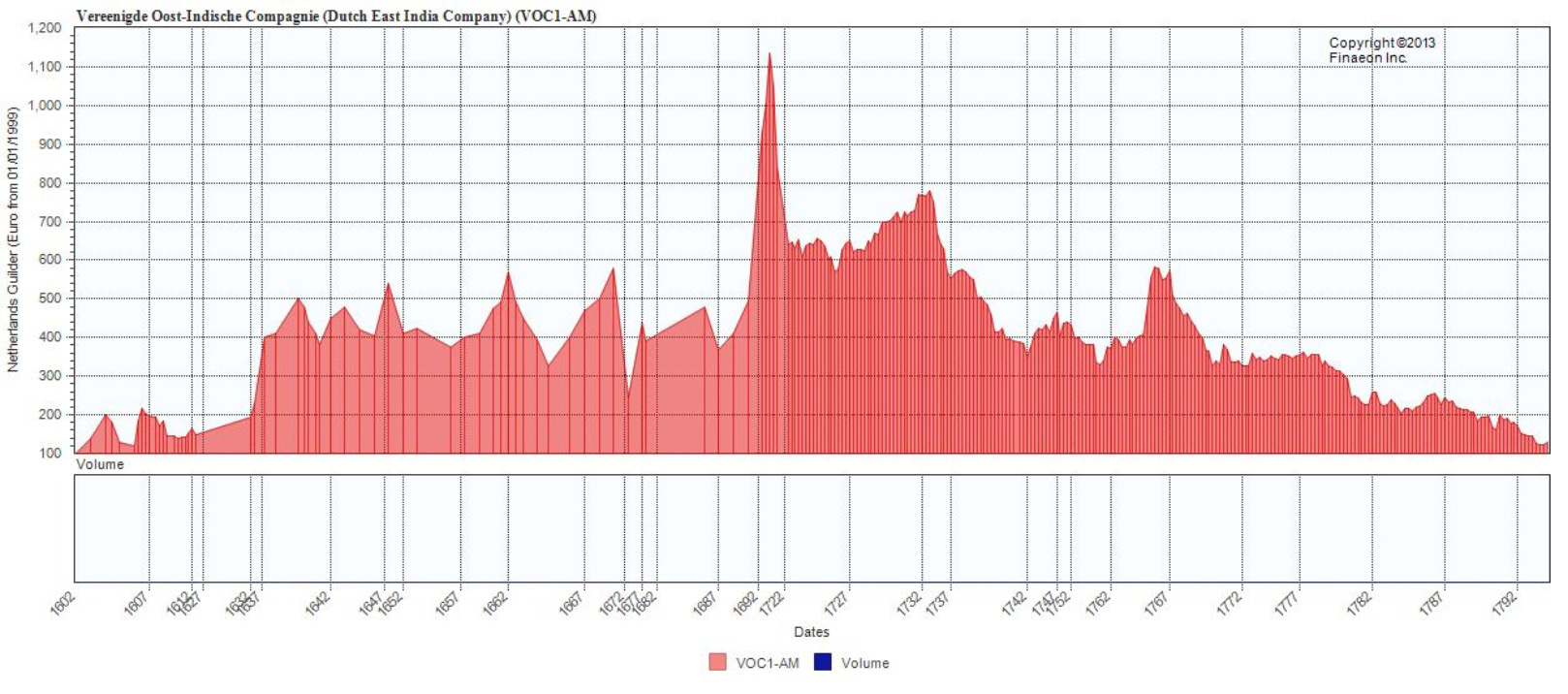
However, the chart also serves as a warning; the VOC’s eventual downfall came when the staggering costs of its private military outpaced its commercial returns and the state finally reasserted its monopoly. It suggests that for the modern technological republic, the only alternative to absolute dominance is total obsolescence.
Similarly, one of the most striking parallels between the VOC’s operations on Kharg and Palantir’s current role is the blurring of the line between commercial interest and sovereign duty. On Kharg, the VOC acted as a surrogate for the Dutch Republic, securing trade routes that the national government could not patrol. In our contemporary context, the software platforms provided by Palantir have become the nervous system of Western intelligence and military operations. When the manifesto calls for the implementation of universal national service or the rearmament of former pacifist powers, the corporation is acting as a geopolitical architect:
“National service should be a universal duty. We should, as a society, seriously consider moving away from an all-volunteer force and only fight the next war if everyone shares in the risk and the cost.”
“The postwar neutering of Germany and Japan must be undone. The defanging of Germany was an overcorrection for which Europe is now paying a heavy price. A similar and highly theatrical commitment to Japanese pacifism will, if maintained, also threaten to shift the balance of power in Asia.”
The total fusion of corporate technology with the military-industrial complex renders traditional democratic oversight nearly impossible. If the software that identifies a target and coordinates a strike is proprietary, then the war itself has been privatized. The ideological framework of the manifesto also revives a civilizational hierarchy that would have been familiar to the colonial governors of the seventeenth century. By explicitly rejecting the pluralistic neutrality of the previous tech era, the manifesto provides a moral justification for Western dominance:
“We should applaud those who attempt to build where the market has failed to act. The culture almost snickers at Musk’s interest in grand narrative, as if billionaires ought to simply stay in their lane of enriching themselves . . . . Any curiosity or genuine interest in the value of what he has created is essentially dismissed, or perhaps lurks from beneath a thinly veiled scorn.”
“We must resist the shallow temptation of a vacant and hollow pluralism. We, in America and more broadly the West, have for the past half century resisted defining national cultures in the name of inclusivity. But inclusion into what?”
This creates a digital-age update of the mission civilisatrice. The VOC justified its brutal monopolies in the East Indies by claiming it was bringing order to a chaotic world; Palantir justifies its dominance by claiming it is protecting the “light of the West” against a rising tide of “totalitarian darkness.” It creates a dependency loop where the state, fearing it will fall behind in an automated arms race, cedes more and more authority to the private entity that holds the keys to the data.

This reconfiguration of conflict also fundamentally changes the nature of accountability. In 1753, if the Dutch chartered company’s actions on Kharg led to confrontation, the Dutch state could theoretically disavow the company while still benefiting from its successes. Today, private intelligence firms allow for a similar degree of plausible deniability. When the Palantir Technologies-linked Maven system was scrutinized after the strike on the school in Minab that killed between 175 and 180 people, most of them girls between the ages of seven and twelve, responsibility dissolved into databases, workflows, contractors, and code rather than resting clearly with any single institution.
The Guardian put it more bluntly:
“LLMs-gone-rogue dominated coverage, but had nothing to do with the targeting. Instead, it was choices made by human beings, over many years, that gave us this atrocity”.
The decisive pressure of the modern era—the control of logistics, satellites, payment systems, and targeting architecture—is a form of warfare that often requires no formal declaration from parliament, only software quietly running in the background.
The shareholders of the VOC were the first to profit from this type of distant, commercialized power projection; the shareholders of Palantir are the latest. The capital is provided by the market, but the authority is supplied by the algorithm.
It suggests that the period of absolute state supremacy was merely a brief window of historical stability. We are returning to a world of digital privateers. The Persian Gulf remains the stage because it is the intersection of energy and data. The VOC on Kharg was attempting to control the flow of silk and spices; Palantir and its peers are attempting to control the flow of information. The tools have changed, but the fundamental logic—the pursuit of commercial advantage through private force—remains identical.
The connection between the VOC’s fort on Kharg and Palantir’s manifesto is a roadmap for the future of power. We are witnessing the collapse of the Westphalian system and the rise of a new corporate sovereignty where cannons and contracts have been replaced by code and contracts.
The era of the state as the sole arbiter of war has closed; the era of the technological republic has begun.
Subscribe to receive my posts directly in your inbox and support my work!

Share this with anyone if you think their attention span can survive more than two paragraphs — and if not, send it anyway. 📨
What do you mean”reviving”? The Chartered Company model is what grew into Incorporation and the baseline code for global capitalism.
This is just a stripped down, barebones version of what the US has always been. It's just that it's too expensive and troublesome to go with the human rights and democracy marketing now.
Even Hollywood has stopped bothering to produce it. When Iranian military geeks make better blockbuster videos than you, you know that the shipped has sailed.
Eventually it always turns to Malacca