The Pacific Pocket
An old military strategy has returned to the Pacific

In August 1944, the German Army in France appeared far from defeated. Despite the Allied landings in Normandy two months earlier, hundreds of thousands of German troops remained in the field. They still possessed tanks, artillery, ammunition, and enough combat power to inflict heavy casualties on the advancing Allies.
Yet, Allied commanders understood something that military planners have known for centuries: the most efficient way to destroy an army is not always to attack it directly. Instead of pushing head-on, American, British, Canadian, and Polish forces began converging on a narrow stretch of countryside around the town of Falaise. The objective was simple: close the gap. As Allied forces advanced from the north and south, the escape corridor available to German units grew smaller by the day. Roads became congested, supplies dwindled, and communications broke down. Every kilometer lost made the German position more precarious.
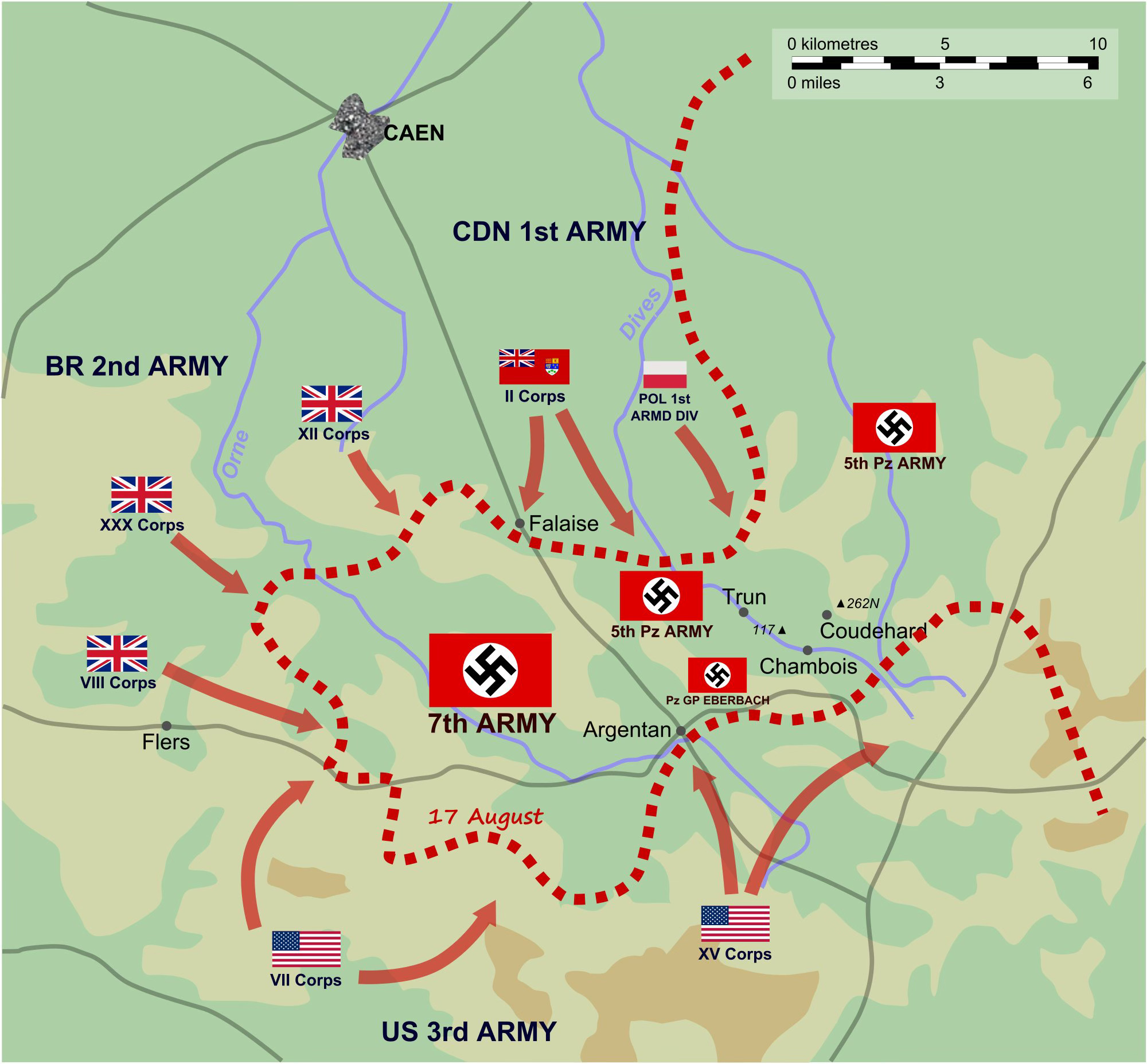
The decisive factor was no longer the balance of forces, but the geography of the battlefield and the Allies' ability to exploit it through encirclement. Once the corridor narrowed sufficiently, German formations found themselves trapped inside what became known as the Falaise Pocket. Thousands were killed, tens of thousands were captured, and vast quantities of equipment were abandoned. What had begun as a fighting retreat turned into a strategic disaster.
The battle offers a timeless lesson: military power is not merely defined by the capacity to destroy an opponent in kinetic warfare; it is equally about the ability to restrict their options. An army cut off from supplies, trade routes, reinforcements, and avenues of retreat can be defeated long before its last bullet is fired.
Eight decades later, this logic is resurfacing on a much larger scale. This time, the theater is not the beaches of Normandy, but the vast expanse of the Pacific. Rather than a direct invasion, the strategy has shifted toward an elaborate, interlocking web of alliances and military positioning designed to constrain Chinese power.
Recent conflicts involving Iran offered a harsh reminder that the ability to disrupt a narrow maritime chokepoint can be enough to send shockwaves through the global economy and impose costs on an adversary so severe that it shapes the course of the conflict itself.
While the Strait of Hormuz demonstrated the principle, the Strait of Malacca magnifies it exponentially. Most of the world’s most strategically important maritime chokepoints happen to be concentrated in Asia, and among them, the Strait of Malacca occupies a uniquely precarious position.
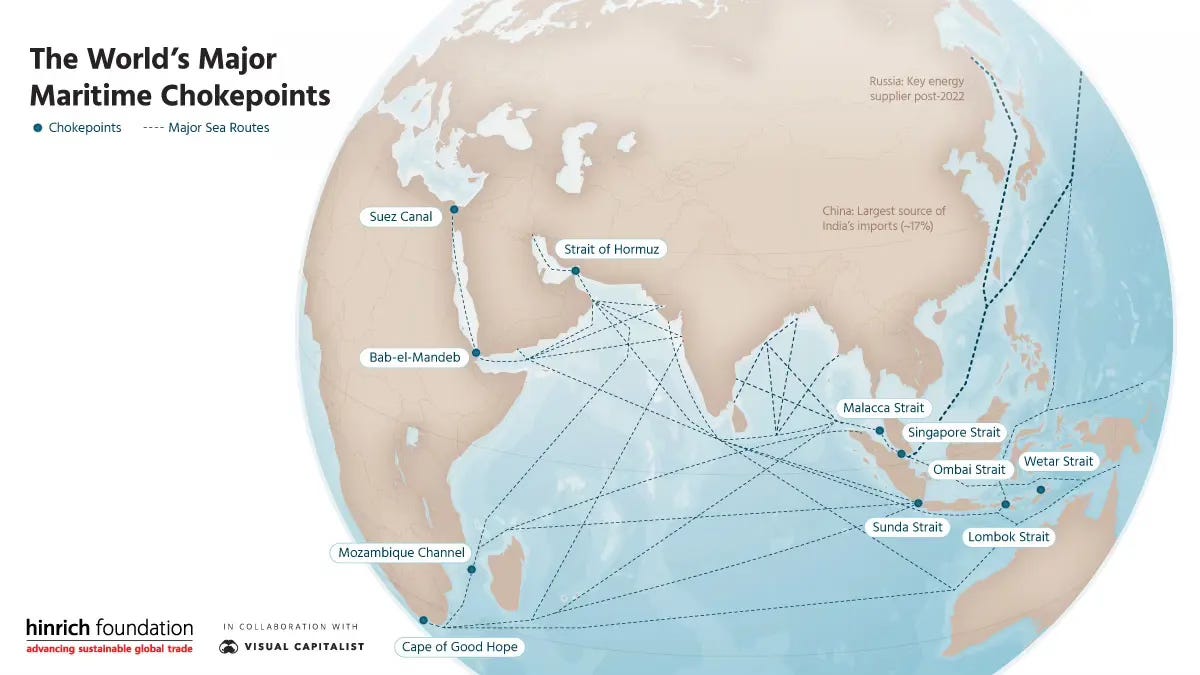
For China, it represents a critical economic lifeline. For U.S. allies such as Japan, South Korea, and Taiwan, it is no less important. Carrying roughly 23.2 million barrels of oil per day, this narrow waterway is the busiest oil transit chokepoint on the planet.
What makes this volume terrifying is the geography: while the Strait of Hormuz is already considered a tight squeeze at 34 kilometers wide at its narrowest, the Strait of Malacca constricts to a mere 2.8 kilometers, forcing more oil than any other maritime passage in the world through a bottleneck a fraction of the size
For the United States, this presents both an immense opportunity and a profound vulnerability. The opportunity is obvious. In a conflict, the Strait of Malacca could become a strategic pressure point on China. Much like the narrowing corridor at Falaise in 1944, a disruption of traffic through the strait would constrain the flow of energy and trade upon which the Chinese economy largely depends.
Yet, this reality cuts both ways. China is not the only nation reliant on the Strait of Malacca; Washington’s own key allies are equally, if not more, vulnerable. Japan, for instance, depends on the strait for over 80% of its oil imports, and Taiwan’s energy security is similarly tethered to these waters. Any attempt by the U.S. to squeeze China through this maritime chokepoint would effectively impose a self-inflicted blockade, causing catastrophic economic and energy supply shocks for its own partners in the region.
Geography, once again, creates both leverage and vulnerability. This reality helps explain a development that has received surprisingly little attention: the unprecidented expansion of the U.S. and allied military presence throughout the Indo-Pacific over the past decade. Military facilities have multiplied across Japan, Guam, Australia, and the Philippines. Access agreements have deepened, new bases have appeared, and existing ones have expanded.
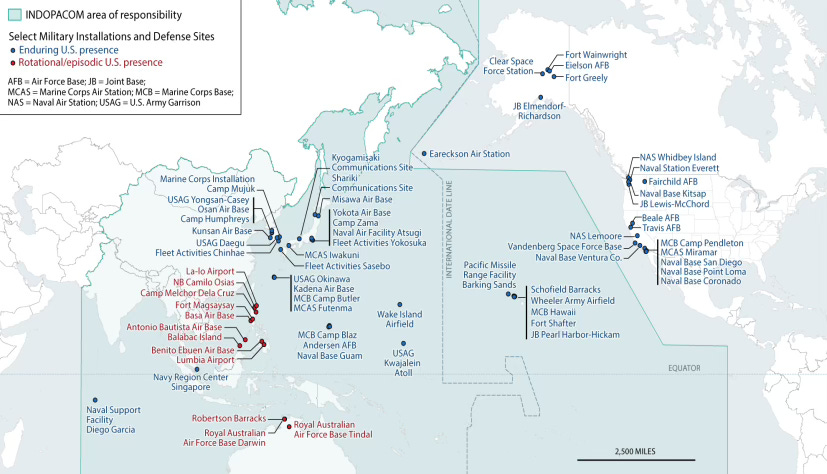
Viewed individually, each move appears purely defensive. Viewed collectively, they begin to resemble a grand strategy to narrow an adversary’s options. A map of the region reveals an increasingly dense network stretching from Japan and Taiwan through the Philippines and onward toward Australia, sitting astride the very maritime routes upon which Chinese trade and energy imports depend. The objective is not necessarily to execute an outright blockade, but to create strategic options. In a crisis, the ability to monitor, defend, contest, or threaten key maritime corridors could prove as strategically valuable as the ability to destroy enemy forces directly.
This is where the AUKUS alliance becomes particularly interesting. The pact recently reached a significant milestone when its three members—Australia, the United Kingdom, and the United States—solidified their subsea cooperation by pledging to co-develop advanced autonomous underwater drones and confirming that American nuclear submarines will begin rotating through Australian ports by next year.
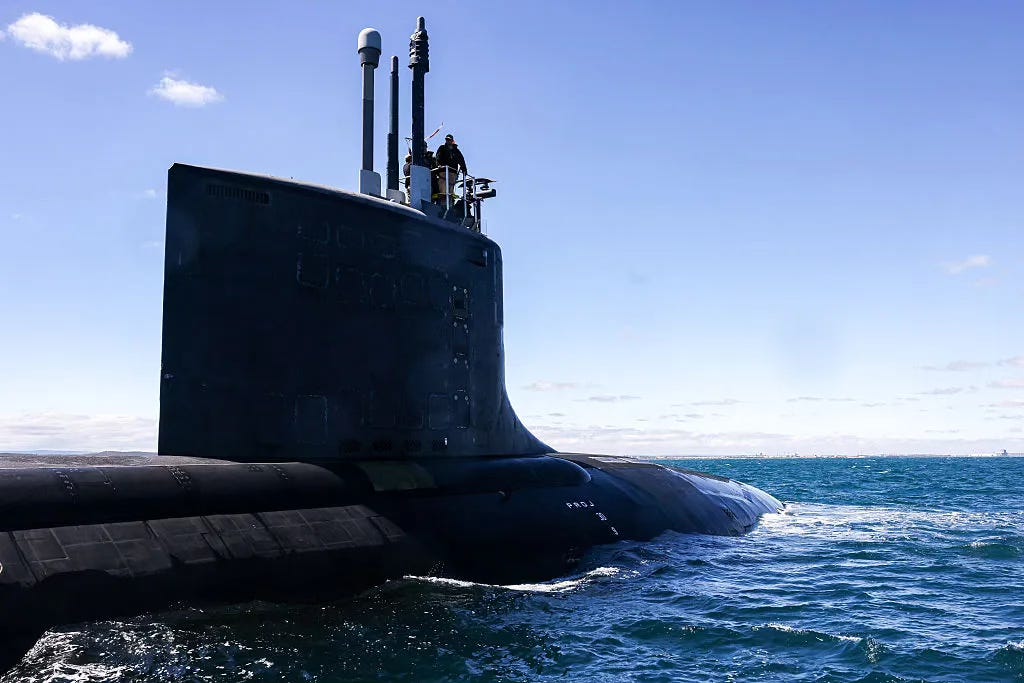
While these announcements command public attention, far less focus is placed on the underlying geography that these new capabilities are designed to control. Australia sits astride the critical sea lanes connecting the Indian Ocean to the Pacific. Any vessel travelling from the Middle East toward East Asia must pass through a relatively small number of maritime chokepoints around Indonesia and Southeast Asia. From bases in Western Australia, allied submarines can operate across a vast stretch of ocean through which much of China’s imported energy and trade must flow.
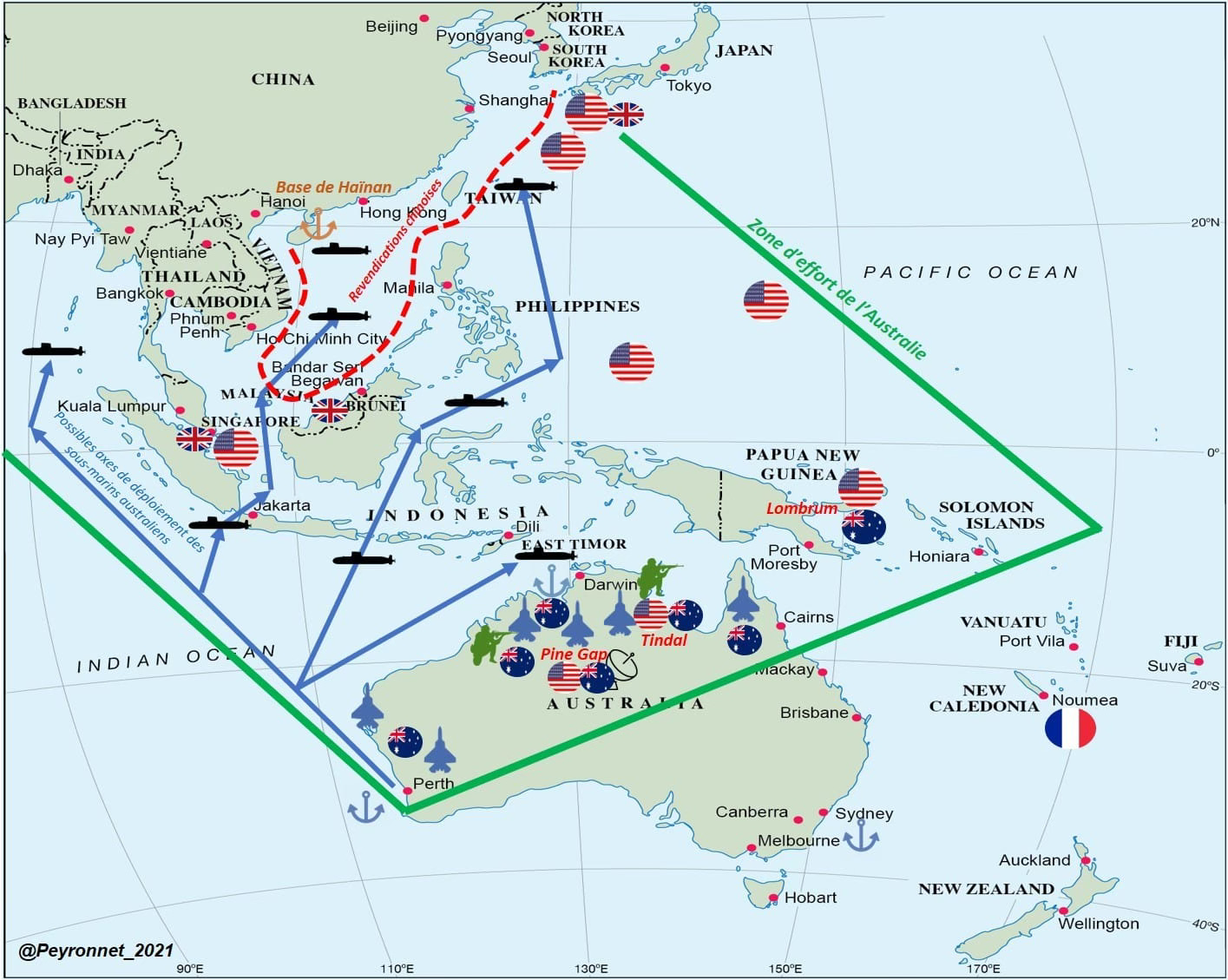
Aircraft carriers may dominate headlines, but submarines shape calculations. A carrier projects power, while a submarine restricts it. Hidden beneath the waves, attack submarines can threaten shipping lanes, monitor naval movements, and force an adversary to devote enormous resources to protecting its maritime lifelines. The significance of AUKUS therefore extends far beyond the transfer of military hardware; it represents a coordinated attempt to increase strategic leverage over the routes that matter most.
Beijing, however, is not blind to this geography. Chinese strategists have long referred to the country’s dependence on the Strait of Malacca as the “Malacca Dilemma.” The concern is straightforward: a nation that imports vast quantities of energy and exports trillions of dollars worth of goods remains dangerously dependent on maritime corridors that it does not control.
As a result, China has spent years aggressively fortifying its presence in the South China Sea, while simultaneously searching for alternatives to bypass critical maritime chokepoints. Some efforts have focused on overland pipelines from Russia, Central Asia, and Myanmar, while others have focused on ports and infrastructure projects stretching across the Indian Ocean. The Belt and Road Initiative, often viewed purely through the lens of development and trade, is fundamentally an exercise in strategic redundancy. A country worried about encirclement naturally seeks additional exits.
This search for alternative routes has recently extended far beyond China’s immediate periphery, stretching across the Pacific to North America. In Canada, the provincial government of Alberta and the federal government are currently closing in on a major agreement to evaluate three northern pipeline routes through British Columbia.
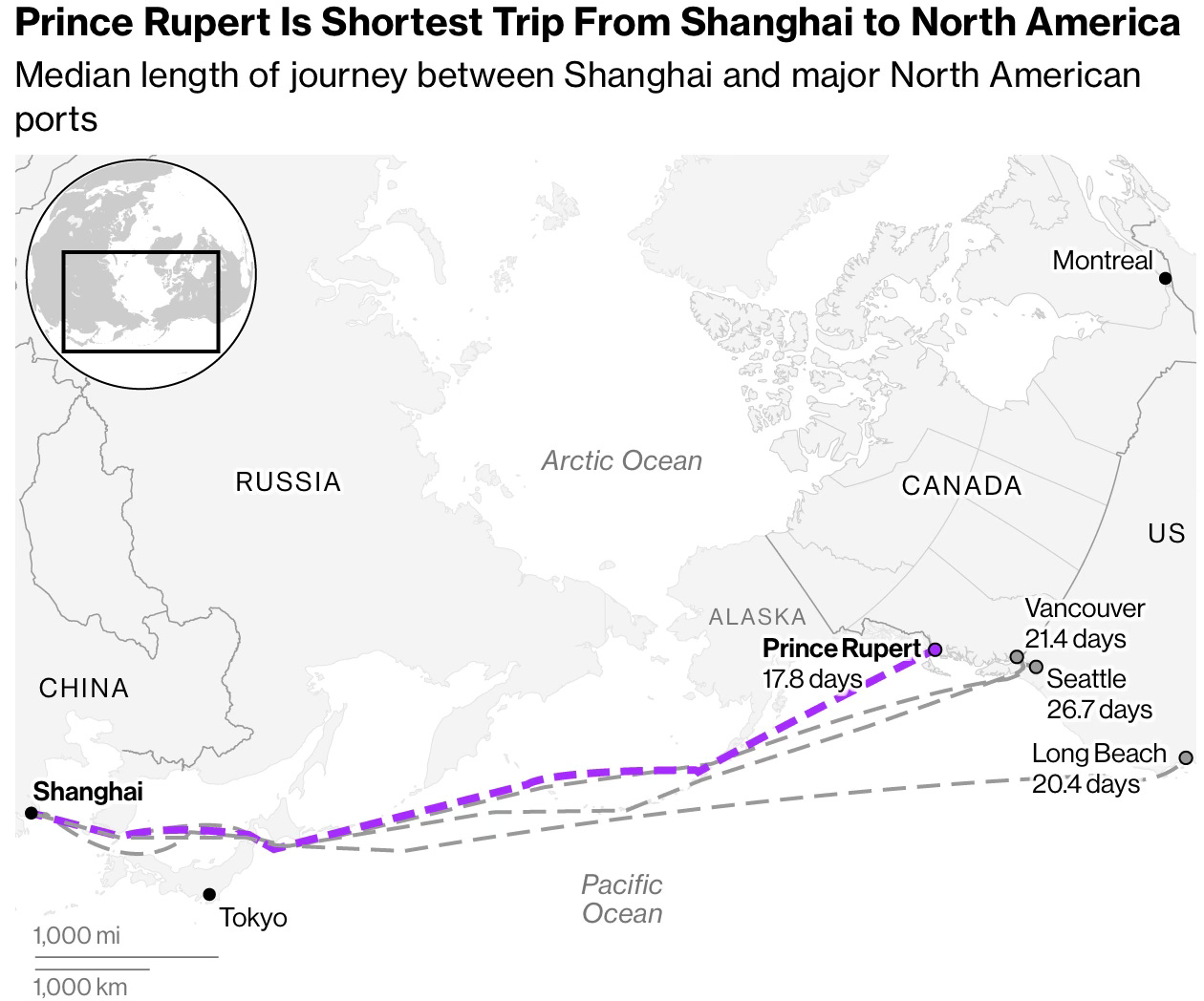
The proposed pipeline would transport up to one million barrels of oil per day to Canada’s Pacific coast, dramatically expanding the country’s ability to export energy to Asian markets. For Ottawa, the project is about far more than energy. It has become a central pillar of a broader economic strategy aimed at reducing Canada’s dependence on the United States and diversifying its trade relationships.
Prime Minister Mark Carney has been explicit about this objective:
“We are going to aggressively develop projects that are in the national interest in order to protect Canada’s energy security, diversify our trade, and enhance our long-term competitiveness”.
Carney argues that President Trump’s tariffs are disrupting global markets and accelerating a restructuring of the international trading system. His assessment of Washington’s approach toward Canada is even more direct. In his view, the United States is seeking to exploit Canada’s economic dependence, making diversification not merely an economic priority but a strategic necessity.
The pipeline should therefore be understood not just as an energy project, but as part of Canada’s broader effort to build greater economic independence in an increasingly fragmented world.
The strategic alignment is already visible in the market. Rongsheng Petrochemical, a privately owned Chinese refining giant that operates a massive 800,000-barrel-a-day refinery on China’s east coast, is currently weighing a long-term agreement to buy crude oil directly from this proposed million-barrel-a-day Canadian pipeline. As China’s biggest buyer of Canadian crude from the existing West Coast terminal, Rongsheng’s interest in securing future supply agreements from this new northern corridor highlights how Chinese commercial interests directly serve Beijing’s grand strategy of diversification. Every barrel arriving from a new, direct Pacific route, and every infrastructure project that bypasses a traditional bottleneck, effectively widens the corridor for China.
Simultaneously, the United States is countering by fortifying its own energy alliances. The $44 billion Alaska LNG megaproject has become a cornerstone of this effort. By liquefying Arctic gas and shipping it directly to Japan, Taiwan, and South Korea, the U.S. is creating a northern bypass. This route is shorter, faster, and—crucially—does not pass through the congested chokepoints of the South China Sea or the Panama Canal. For the U.S., this project is a tool of energy security: it provides allies with a reliable, non-Middle Eastern energy source. For China, the race for these Canadian and Alaskan alternatives is a fight to keep their exit open.
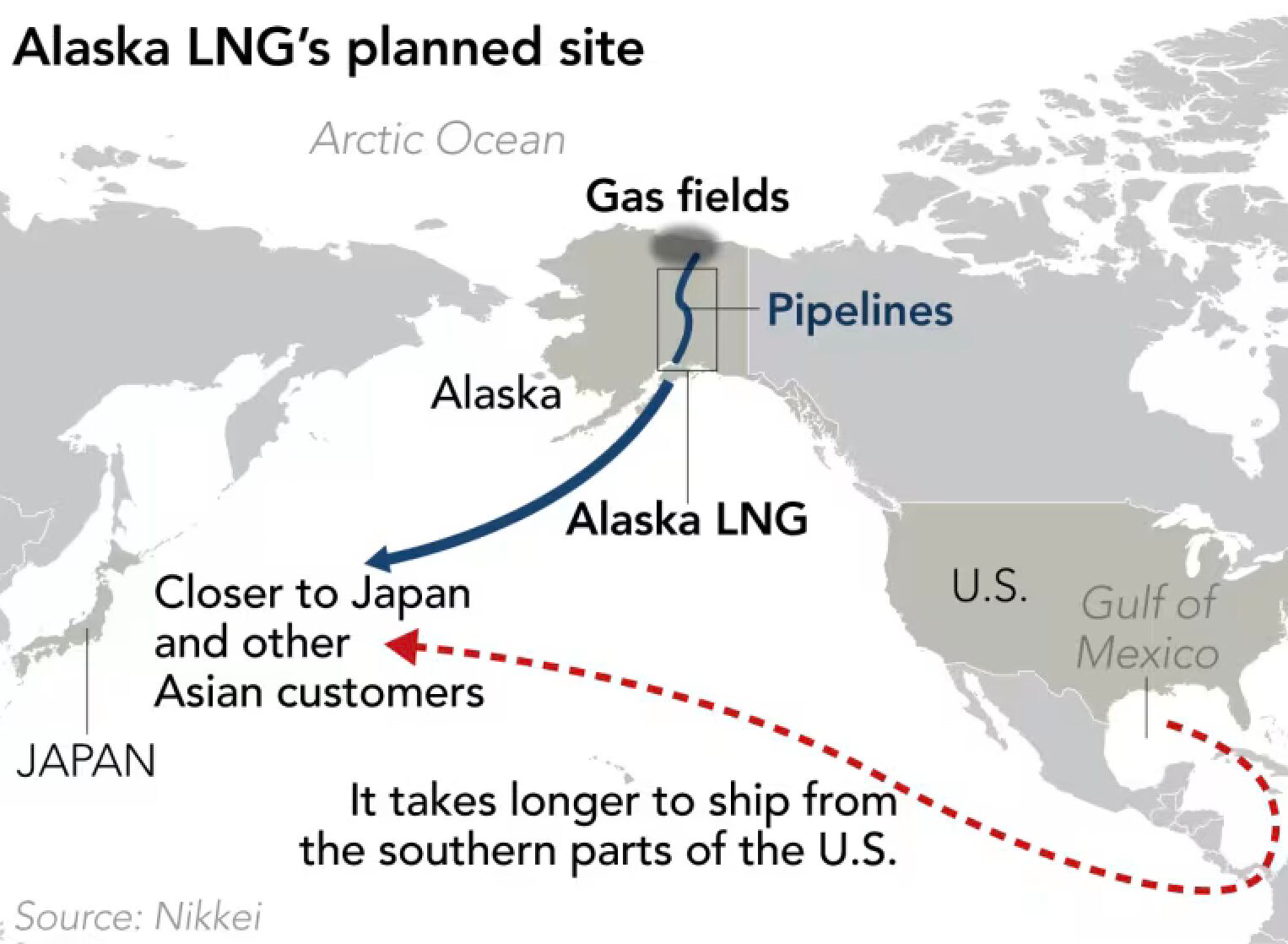
Viewed together, these developments—from submarine patrols in the Pacific Ocean to pipeline negotiations in Canada and Alaska—reveal the contours of a global contest. The United States and its allies are attempting to preserve a maritime system that grants them supreme strategic leverage. China is fighting to build an intricate web of alternative supply lines to survive that system.
One side seeks to narrow the options; the other seeks to expand them. The lesson of Falaise was not that superior firepower wins wars, but that limiting an opponent’s freedom of movement is the ultimate victory. Eighty years later, the principle remains unchanged. The battlefield has simply expanded from a pocket in Normandy to a global network of straits, ports, and pipelines.
The question facing Beijing and Washington alike is the same one that confronted the German Army in August 1944: how many exits remain when the gap begins to close?
If you enjoyed this article, consider subscribing for free to receive future posts directly in your inbox and support my work.
Share this with anyone if you think their attention span can survive more than two paragraphs — and if not, send it anyway. 📨
The more energy the better. That is an absolute.
I applaud Canada’s willingness to make China dependent on her energy. Er, sovereignty something something, yes.
Your analysis of this is fascinating, as always.
The Malacca Dilemma frame makes a lot of sense, I did not think of that. One chokepoint can throttle the whole Chinese economy, which is exactly why Beijing has been quietly building alternatives i.e. Russian pipelines, Belt and Road ports across the Indian Ocean, now the Canadian Pacific route. Belt and Road reads as exit-building rather than trade expansion I think.
I wonder if the exits are being built fast enough to matter, knowing the efficiency Chinese building, they probably are!