
Undefined Horizon
The rise of Guyana’s oil economy and its quiet integration into Washington’s hemispheric strategy

In one decade Guyana’s name has flipped from a quiet coffee-and-rice export economy to the most consequential new oil story in the Western Hemisphere, a transformation that now cuts through U.S. strategic calculations with a clarity rarely seen outside major power competition.
This is the backdrop for how Georgetown’s crude wealth is entangling with Washington’s energy and security agenda in 2026.
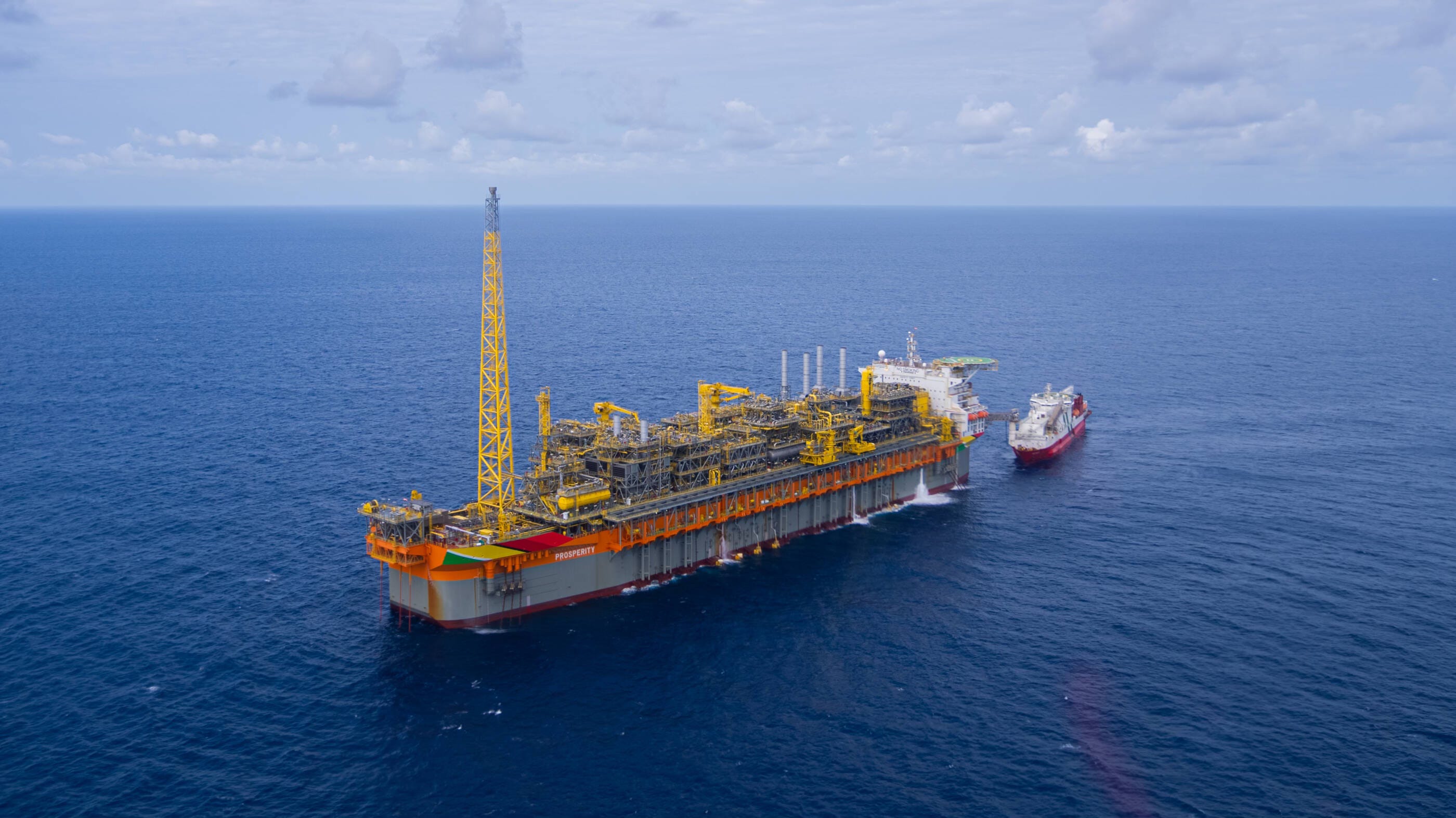
When ExxonMobil and its partners first hit black gold offshore in 2015, it was the beginning of something much larger than a new producer on the map. Successive finds in the Stabroek Block now hold an estimated 11 billion barrels of recoverable oil, placing Guyana among the fastest oil-rich growth stories of the century.
Production began in December 2019. By the end of 2025, output had climbed steadily to roughly 900,000 barrels per day (bpd), a figure few would have foreseen a decade earlier, and is on track toward 1.3 million bpd by 2027 or even as high as 1.7 million bpd by 2030as new projects come onstream.
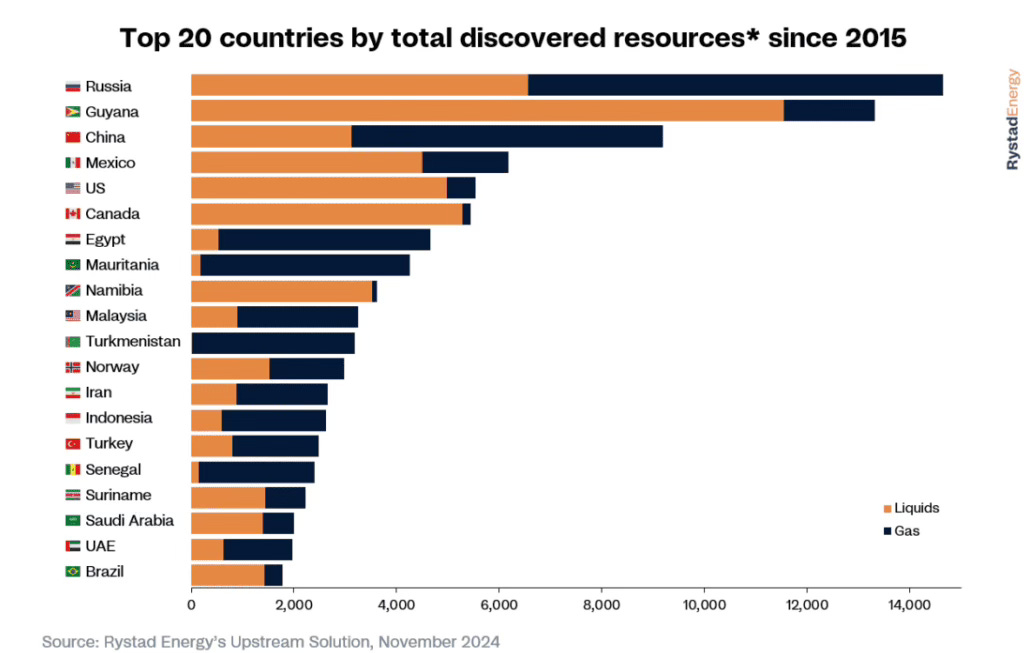
The scale of this transformation becomes clearer when placed in global context. Since 2015, Guyana ranks among the top countries worldwide in total discovered hydrocarbon resources, second only to Russia in liquids discoveries. For a country of fewer than one million people, this positions Guyana not as a marginal producer, but as one of the most significant new petroleum provinces of the past decade.
It is also among the most cost-competitive new oil provinces globally, with average production costs of roughly $30 per barrel, positioning Guyana as one of the cheapest, and therefore most profitable, places in the world to extract crude.
What makes this evolution distinctly American, and strategically resonant, is the structure of capital and control beneath it. The consortium operating the entire Stabroek play is dominated by U.S. firms: ExxonMobil holds a 45% stake, Chevron (through its 2023 acquisition of Hess’s 30% interest) now controls an effective 30%, with the Chinese state-owned CNOOC holding the remaining 25%.
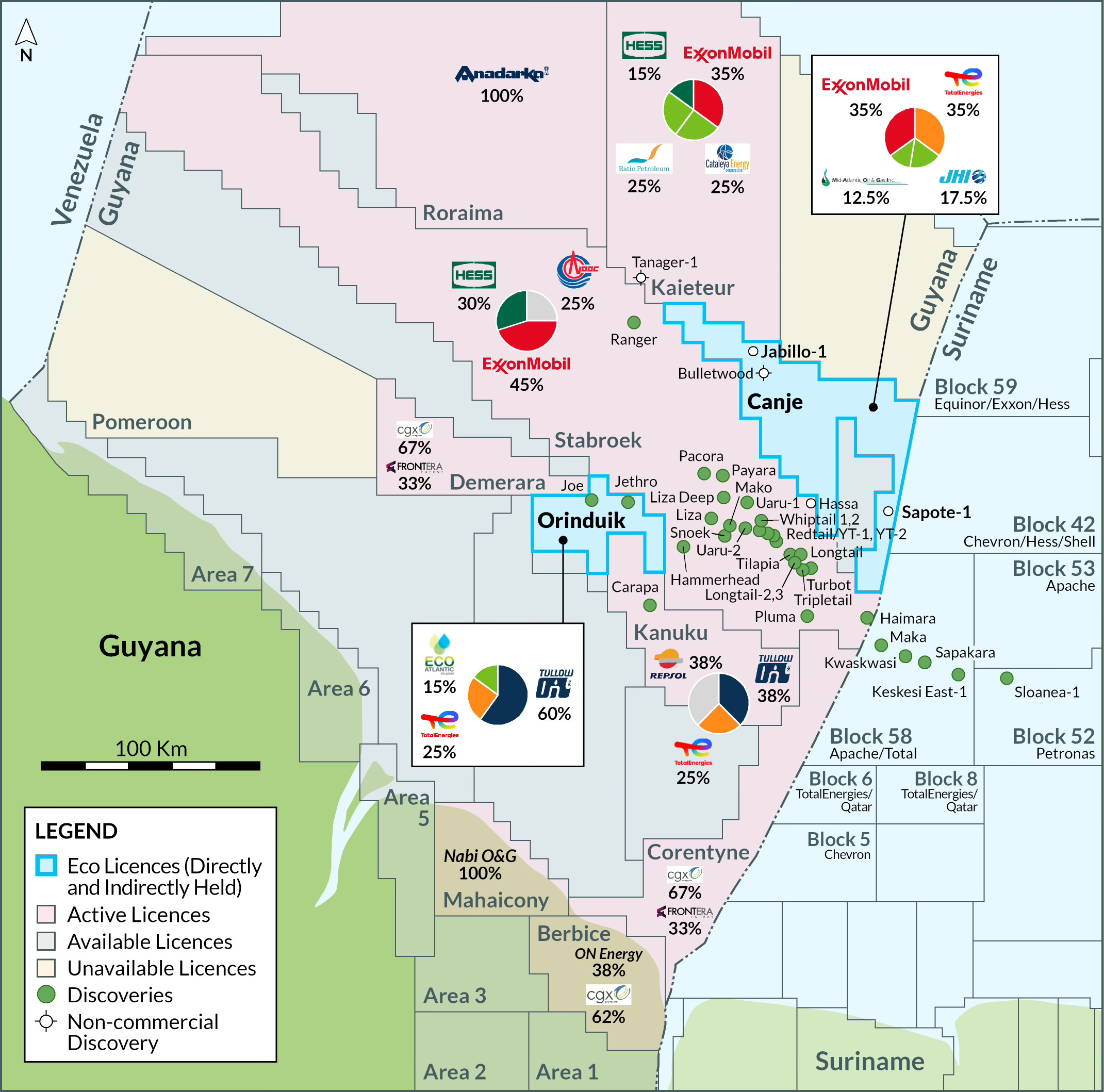
In practical terms, that means roughly three-quarters of all producing oil and the heart of Guyana’s nascent energy economy is directed by U.S. oil capital, from investment decisions to how revenues flow back into global markets.
Under the 2016 Stabroek PSA, Guyana collects a 2% royalty while allowing up to 75% of revenues to be recouped as costs before profits are split, with corporate taxes paid from the state’s share.
This structure front-loads returns to operators and delays meaningful fiscal gains. Such terms, negotiated at a time when Guyana lacked institutional experience in petroleum governance, have locked the country into a framework that limits early revenue capture while granting operators extensive control over cost recovery and project pacing.
By contrast, early post-independence Trinidad and Tobago imposed royalties of 10–12.5%, securing a larger upfront state take. Guyana’s terms — marked by low royalties, expansive cost recovery, and limited early oversight — tilt the balance toward foreign operators and defer national benefit. The concern, increasingly voiced in domestic and regional commentary, is that while production numbers soar, fiscal sovereignty and policy flexibility remain constrained by contractual asymmetries.
But the geopolitical overlay here is where the economics begin to warp into strategy.
Like what you’re reading? Subscribe for free to Financial Compass to get new articles delivered straight to your inbox. 📥
For more than a century, Guyana and Venezuela have been engaged in a territorial dispute over the Essequibo region, which makes up roughly two-thirds of Guyana’s land territory. The 1899 arbitration ruling fixed the boundary when Guyana was still British Guiana, but Venezuela later rejected the award and continues to contest it before the International Court of Justice.
That dispute extends offshore. The Stabroek Block lies within Guyana’s internationally recognized Exclusive Economic Zone, yet close to waters Venezuela has at times claimed, turning a historic land boundary disagreement into a high-stakes contest over adjacent maritime oil reserves.
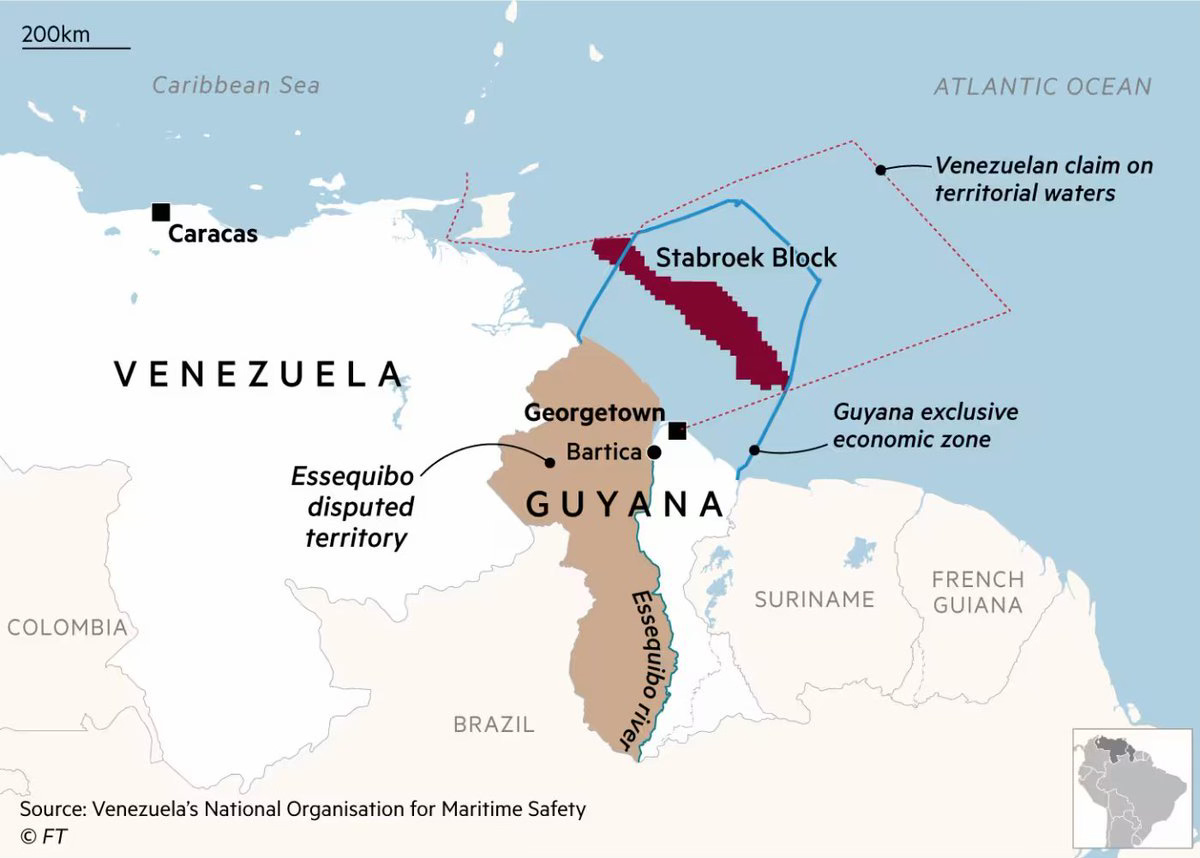
However, following the U.S. intervention in Venezuela and the capture of Nicolás Maduro in 2026, Caracas’s ability to actively press or escalate that claim has been significantly curtailed, at least for now. The dispute remains legally and diplomatically unresolved, but it is no longer unfolding as an immediate military flashpoint.
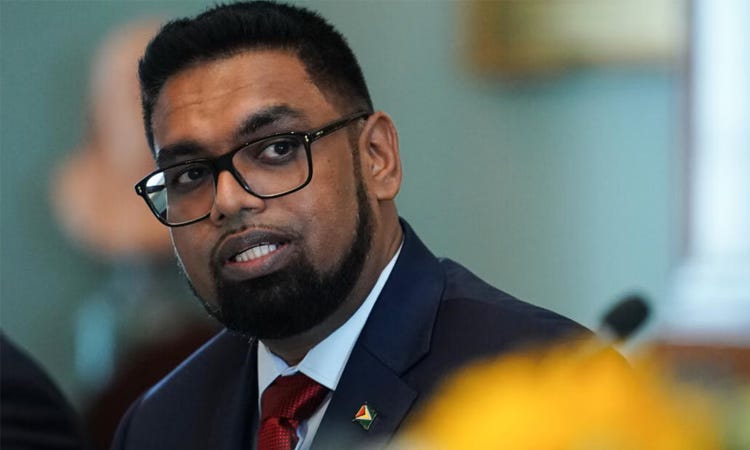
Last month, Guyana’s President Irfaan Ali addressed his thoughts directly when asked about Washington’s apparent expansionism in the Caribbean and suggestions that the border controversy with Venezuela could be amicably settled by granting Caracas concessions:
“My priority is the safety and security of the Guyanese people and on the integrity of our borders, our territorial integrity and our sovereignty and nothing in that relation will ever be compromised.
We are partnering with technology. We are partnering with innovation. We are partnering with the people. We are partnering with communities because we know that your investment depends heavily on a stable and secure environment,”
Washington’s posture under President Trump’s 2026 agenda treats these developments less as isolated energy projects and more as cogs in a broader hemispheric strategy. A security meeting slated for March in Miami — extended invitations to Guyana and other key Caribbean Community (CARICOM) allies — underscores this pivot: narcotics interdiction, maritime domain awareness, and combatting transnational organized crime are on the agenda, but the subtext is unmistakable.
For U.S. policymakers, Guyana now represents both an energy asset and a strategic foothold on the northern shoulder of South America, a position too valuable, in their view, to drift toward competing spheres of influence.
The optics are deliberate. At a late-February CARICOM summit, Washington calibrated its messaging around Cuba and Venezuela as sources of regional instability. A way of tying Gulf Coast geopolitics, Caribbean security, and Guyana’s energy production into a single strategic narrative.
For Georgetown, the calculus is fraught. Aligning more deeply with U.S. security frameworks promises training, equipment, and institutional buildup. But it also signals to Caracas, Moscow, and even Beijing that Guyana’s oil wealth is now embedded in Washington’s hemispheric blueprint.
The financial flows reflect this entanglement. Exxon and its partners have committed more than US $60 billion into developing multiple Stabroek projects, with Uaru and Whiptail alone expected to add hundreds of thousands more barrels per day in the next few years. Yet the fiscal terms under which Guyana accrues revenue remain a point of contention.
Much of the current production shares revenues under agreements that favor foreign operators, a structure that raises questions about how much long-term economic resilience Guyana is building versus how much it is ceding leverage to external capital.
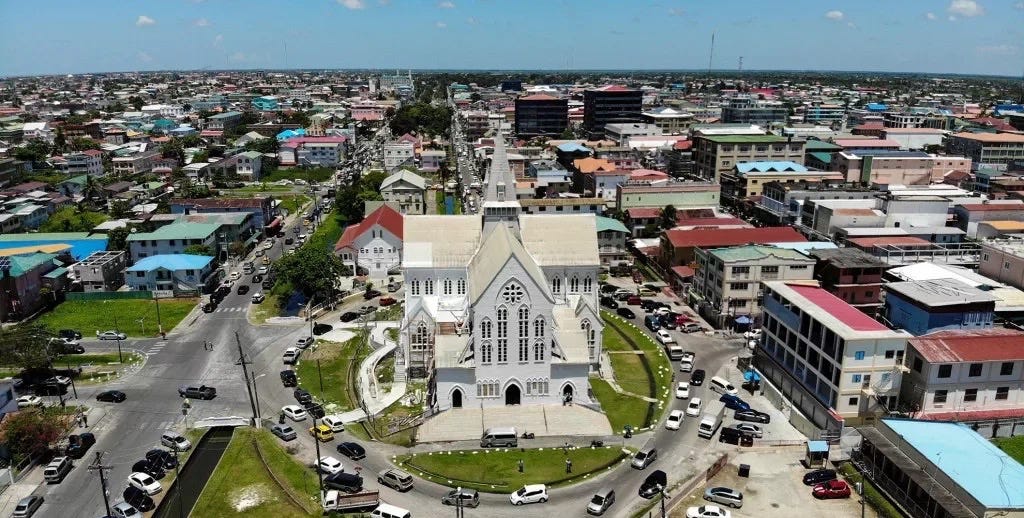
In strategic terms this no longer is a story of oil volumes or tax take alone. It is about positioning in a hemisphere where energy, diplomacy, and military cooperation are increasingly inseparable. Guyana’s boom has made it an indispensable node for U.S. energy supply chains, yet also a potential flashpoint if regional disputes over borders and influence deepen.
The promise of prosperity is real, but the risk lies in how that promise is managed. Venezuela, despite sitting on some of the largest proven oil reserves in the world, saw production collapse from over 3 million barrels per day in the 1990s to less than 1 million today amid mismanagement, sanctions, and institutional decay, illustrating that reserves alone do not guarantee sustained wealth.
For Guyana, the question is not just how much oil it produces, but whether its governance, contract terms, and strategic alignments can translate resource wealth into broad, lasting development rather than the patterns seen in neighboring oil states.
The promise of prosperity may be real, but whether that promise leads to inclusive development or echoes the pitfalls of other petroleum-dependent economies remains to be written in Georgetown, Washington, and beyond…
Share this with anyone if you think their attention span can survive more than two paragraphs — and if not, send it anyway. 📨