
Peak Everything
The psychological, philosophical, and historical dimensions of our impending material limits.

Lately, I have written regularly about resources. As readers of this publication know, recent years have been defined by a global race to secure them—almost at any cost. It therefore seemed fitting to explore the other side of the equation through a series of essays that step back from my usual posts. Rather than focusing on climate or environmental policy, this essay series explores the forces behind our ever-growing demand for energy and raw materials.
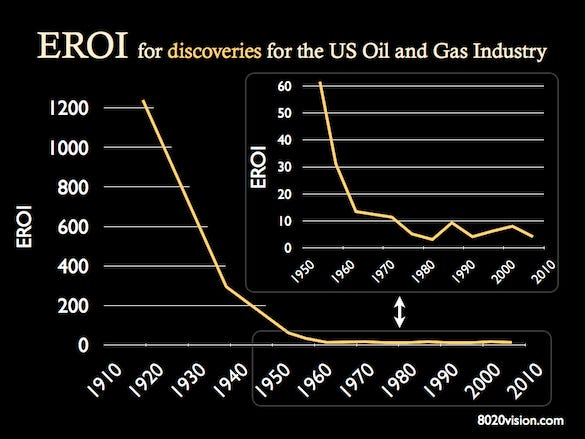
In the early twentieth century, a physical miracle occurred in the oil fields of Texas that would permanently alter the trajectory of human history. Anyone who drove a drill into the ground was often rewarded with a towering geyser of black gold. The energetic calculus of those early days was spectacularly simple: the energy of one single barrel of oil was enough to pump out one hundred new barrels. This fabulous ratio, known in ecological economics as the Energy Return on Energy Investment (EROEI), formed the invisible stevedore of the modern world.
This spectacular energetic surplus became the flywheel behind skyscrapers, globalization, medical revolutions, and the explosive growth of the global population. It built the modern world as we know it. But as the twenty-first century progresses, that effortless geyser has fallen silent.
Today, the global EROEI is generally estimated to be between 7:1 and 11:1, a critical threshold given that a societal break-even point requires at least 7:1 to maintain complex socioeconomic structures. With the investment of that same barrel of oil now yielding only ten or fewer, we are running harder than ever before, both psychologically and technologically, simply to remain stationary in energetic terms.
This phenomenon now extends far beyond the boundaries of the oil sector. The concept of Peak Everything dictates that we have reached the apex not only of fossil fuels, but of nearly every critical raw material upon which our civilization rests. Whether it is the copper required for the energy transition, the indium in our touchscreens, or the phosphate that keeps our agricultural lands fertile, the law of diminishing returns reigns mercilessly.
Within a century, fundamental building blocks of our physical reality risk becoming logistically and economically out of reach. Yet the true crisis arising from this is not merely ecological or geopolitical in nature. It is, in essence, a psychological and philosophical crisis. The approaching material scarcity confronts humanity with the deepest flaws of its own psyche and forces a painful reconsideration of its place in the cosmos.
To understand why humanity collectively refuses to anticipate these approaching boundaries, we must descend into the evolutionary architecture of our brains. The human psyche is hardwired for the short term. During the millennia our species spent hunting and gathering, anticipating an acute threat—such as a predator or a sudden winter—was the key to survival. This has led to what we call hyperbolic discounting: our persistent tendency to value a direct, tangible reward in the present far more highly than the abstract implications of a catastrophe in the future.
Our brains are evolutionarily tuned to the absolute present, erupting into a fireworks display of neural activity the moment we experience instant gratification. This occurs because the brain utilizes hyperbolic discounting as a core learning mechanism, driven by the basal ganglia.
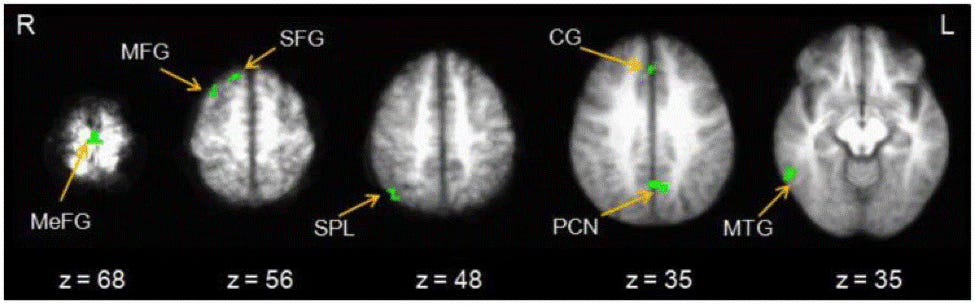
The basal ganglia are a group of brain structures linked together, handling complex processes that affect your entire body. While best known for their role in controlling your body’s ability to move, experts now know they also play a role in several other functions, such as learning, emotional processing and more.
This deep-seated neurological craving for immediacy finds its perfect monument in modern technology. Our evolutionary blindness to the future allows us to enjoy the digital world while remaining completely disconnected from the massive geological toll required to build it.
Take the object almost certainly within your reach right now.
Purchasing (and using) a shiny new smartphone grants the brain an immediate shot of dopamine, yet few realize the immense material scarcity compressed into those 170 grams of glass and metal. A single device is a geological anomaly, crammed with up to 70 different elements—including 16 of the 17 rare earth metals. To manufacture just one phone, miners must blast over 30 kilograms of raw rock to extract mere fractions of these finite materials.
A typical screen hoards roughly 30 milligrams of indium—mined in depleting deposits in China—just to create the conductive, transparent film that makes the touchscreen function. Deeper inside, its hardware relies on mere milligrams of neodymium from Inner Mongolia, about 8 grams of cobalt dug out under hazardous conditions in the Democratic Republic of Congo, and microscopic traces of europium and praseodymium to give the display its vibrant colors.

This brutal physical reality, however, remains completely invisible to the consumer. The knowledge that its extraction burns through critical materials destined for functional extinction within decades is an abstraction that simply fails to trigger our emotional alarm system.
This short-sightedness is amplified by what economist and Canadian Prime Minister Mark Carney called the tragedy of the horizon. The existential horizon of the resource crisis lies just beyond the four-year political cycle, and just past the horizon of the average individual career or quarterly corporate report. Because the pain of transition must be suffered now, while its reward—the prevention of a collapse—lies far in the future, the societal machine invariably chooses postponement.
This procrastination is made psychologically bearable by the subtle but destructive mechanism of the shifting baseline syndrome. Generation after generation, our perception of what constitutes a 'normal' world shifts. A child growing up today in a world scarred by structural depletion and simmering scarcity experiences this situation as the absolute baseline. Because we forget what the world looked like in times of true ecological abundance, we normalize the decline. Scarcity becomes familiar, which paradoxically causes the psychological urgency to turn the tide to vanish as the crisis worsens.

Philosophically speaking, the denial of these physical limits is the ultimate expression of modern world hubris. Since the Enlightenment, humanity has cultivated itself as a Promethean figure: a being that believes human ingenuity and technology can stretch any material boundary. In this worldview, scarcity is not an absolute barrier, but a temporary problem to be solved by a market mechanism or a new invention. We refuse to accept that the laws of thermodynamics are inexorable and that technology does not generate energy, but merely transforms it at the expense of increasing entropy.
The philosopher Martin Heidegger foresaw the spiritual emptiness of this stance in the last century. He argued that modern man has come to view the world as a Gestell, an all-encompassing framework in which nature is reduced merely to a Bestand: an exploitable standing reserve. An ancient forest, in this view, is not a living ecosystem, but a potential stock of timber. A rushing river is not a landscape feature, but a source of megawatts. When this global storeroom runs empty and the physical boundaries close in, not only does our economy collapse, but so does our entire system of meaning-making. If the world only had meaning as an object to be consumed, what remains of the human being when there is nothing left to consume?

The answer is a profound, existential crisis bordering on the absurd. We resemble the mythical Sisyphus from Albert Camus's essay, condemned by the supreme god Zeus to push a massive boulder up a mountain, only to watch it roll back down each time he nears the summit. Our boulder is the promise of infinite economic growth, and the mountain is a finite planet that can physically no longer support that growth. The refusal to face this absurdity drives us to ever more extravagant technological fantasies, such as asteroid mining, while the ground beneath our own feet is swept away.
When we shift our gaze from philosophical theory to historical practice, we see that this psychological blindness is not a new phenomenon, but a pattern that has played out across different scales throughout the centuries. History offers us terrifyingly accurate anchor points for the dynamics in which we find ourselves today on a global scale.

The most iconic and tragic example of this is the history of Rapa Nui, better known as Easter Island. The inhabitants of this isolated island developed a complex culture centered around erecting gigantic stone statues, the moai. The transport and construction of these statues required vast quantities of tree trunks. As the centuries passed, the forest cover steadily declined. The islanders must have seen that the trees were nearly gone. Nevertheless, deforestation and statue construction continued unabated until the very last tree was felled. The social hierarchy, religious prestige, and economic structure were so deeply intertwined with this destructive process that it proved psychologically impossible to stop.
Today, the global community behaves exactly like the residents of Rapa Nui. Our artificial intelligence data centers, our gargantuan logistical networks, and our consumer drive are the modern moai. We sacrifice the last critical resources and the stability of the biosphere to the idol of technological progress, powerless to break the dynamic leading us toward the abyss.

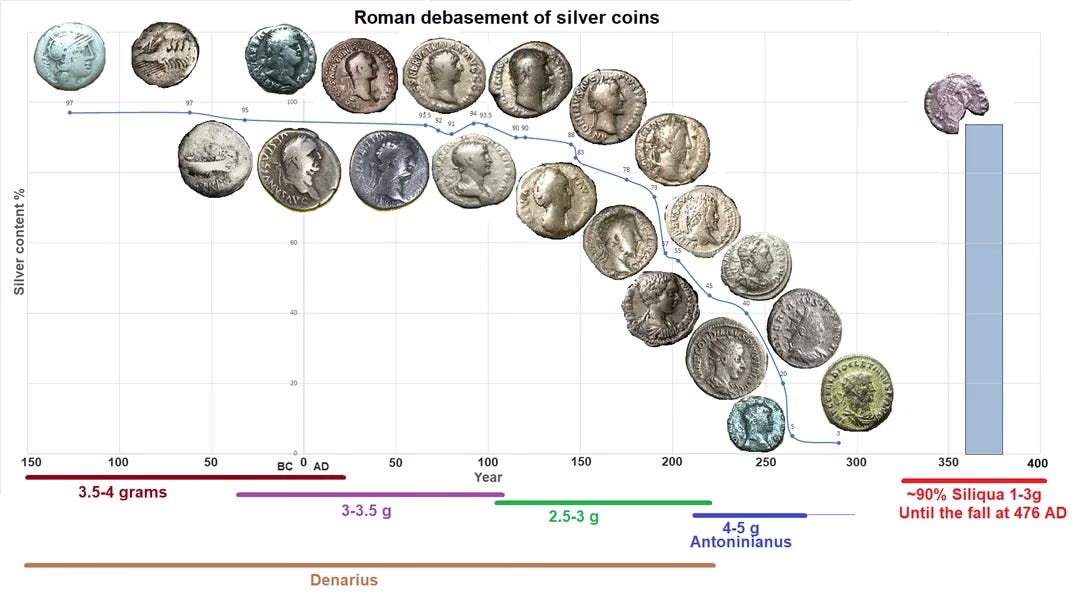
Another historical anchor point illustrating the economic and psychological masking effects of scarcity is the decline of the Roman Empire. The empire was essentially a machine fueled by expansion; conquering new territories brought fresh supplies of slaves, grain, and, above all, precious metals like silver. When the empire's borders reached their logistical and military limits, the influx of new silver from the mines stalled. The Roman state was confronted with an early variant of declining energy returns: the costs of maintaining the massive military apparatus rose, while real revenues fell.
Instead of accepting this physical reality and scaling back consumption, the emperors resorted to a psychological ruse. They began systematically debasing the silver content in the Roman coin, the denarius, melting the silver and mixing it with cheaper metals like copper. The coin still looked more or less the same, but its real value evaporated, leading to devastating hyperinflation and the eventual fragmentation of the empire. In our modern era, we witness the exact same dynamic.
We mask the physical decline of our resource base and rising energetic costs by building astronomical mountains of debt—perfectly epitomized by a soaring US national debt that has now breached the staggering milestone of 39 trillion dollars—and creating unlimited fiat money. Economic indicators suggest we are still growing richer, but this monetary expansion is a hallucination hiding the real, physical degradation of the planet from view.
It is a psychological illusion of numbers that turns math into something closer to science fiction. As Jon Stewart famously observed on The Daily Show during the 2011 debt crisis:
The debt ceiling is a fictional construct, but the debt itself is very real. It’s got eleven zeros in it. When a number has that many zeros, it ceases to be math and becomes a visualization exercise for astronomy.
Since that observation, the astronomical exercise has only worsened; another zero has been added to the ledger, bringing the total to twelve zeros.
The geopolitical translation of this scarcity is likewise rooted in the past. In the nineteenth century, intensively farmed European agricultural lands became depleted of nitrogen and phosphate, threatening famine for rapidly growing urban populations.
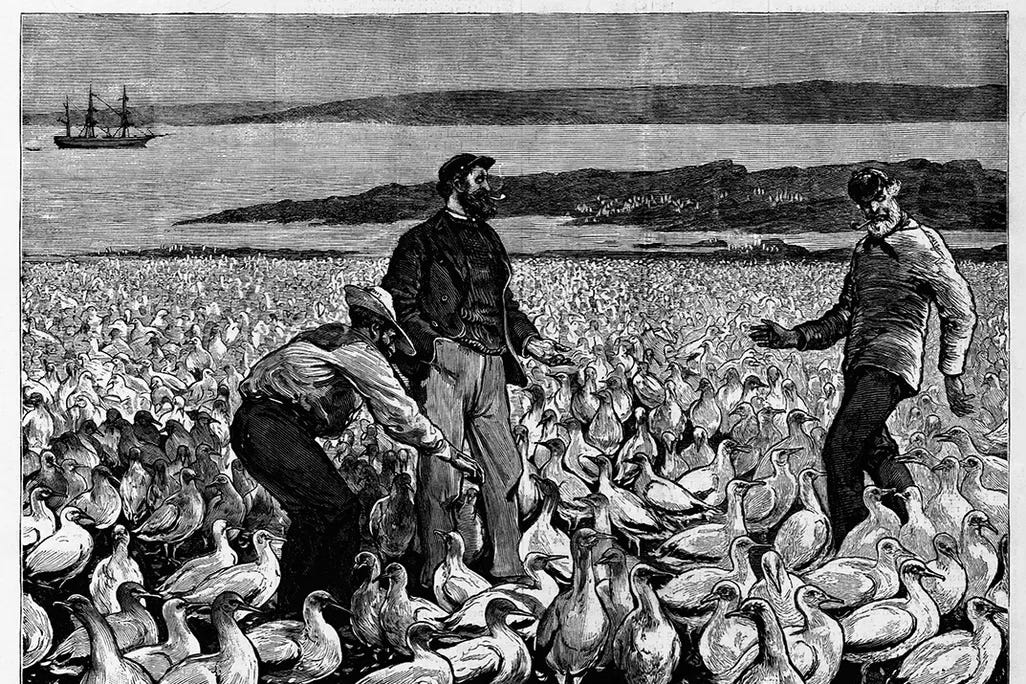
The discovery of immense quantities of guano—ancient deposits of seabird excrement rich in phosphates—on remote islands off the coast of Peru ignited a veritable geopolitical stampede. Great powers like the United States and Great Britain fought bitter diplomatic and military battles over the possession of these seemingly insignificant rocky outcrops. The American Guano Islands Act even gave US citizens the right to claim any uninhabited island containing guano deposits as American territory.
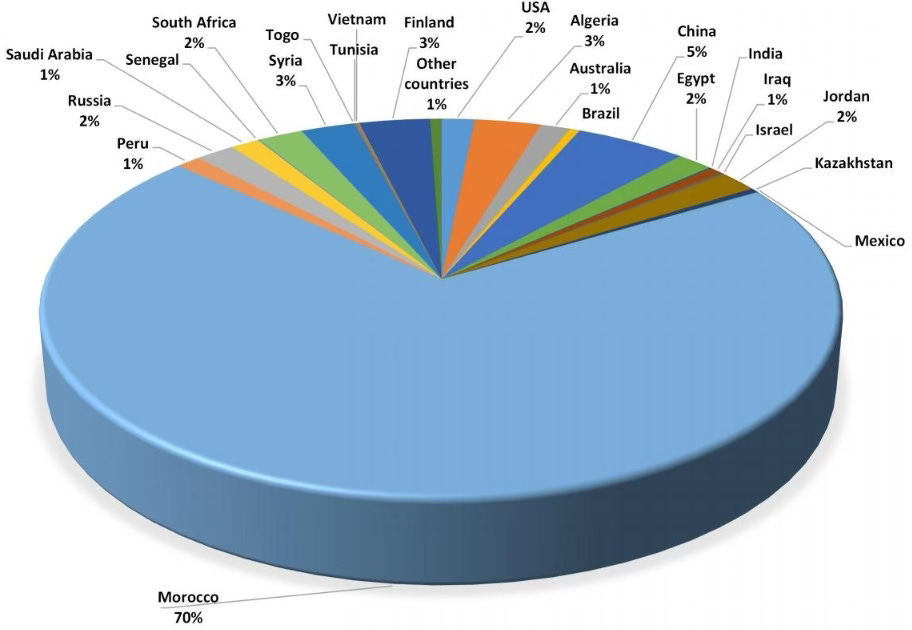
Today, this history repeats itself with chilling precision, but at the level of elements like lithium, cobalt, and once again, phosphate. The vast majority of the remaining, extractable global supply of phosphate—essential for feeding the current 8 billion humans—is located in Morocco and the disputed territory of Western Sahara. The geopolitical tensions in that region are not merely a local conflict, but the modern variant of the guano wars. Without this specific mineral, the global food supply would collapse within a few generations, demonstrating just how precarious the foundation of our hyper-modern civilization truly is.
What binds all these historical and philosophical threads is the reality that humanity is being confronted with a boundary it cannot accept by its very nature. The laws of physics dictate that a system based on infinite material expansion within a closed, finite space is doomed to stagnation and implosion.
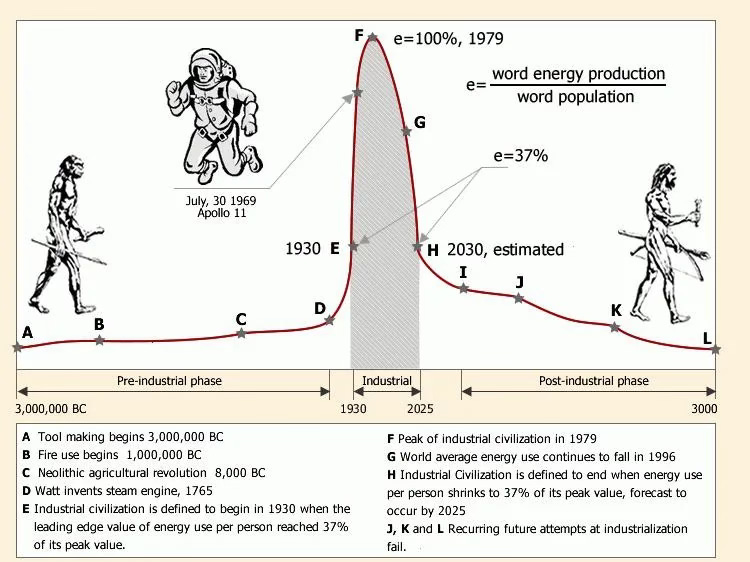
Richard Duncan’s law, better known as the Olduvai Theory—conceived in 1989—outlines a dark but illuminating scenario in this regard. Duncan argued that industrial civilization, peaking around 2025 and characterized by unprecedented material consumption per capita, is merely a short-lived anomaly in human history; a flash in the night that will last barely a century, after which humanity, due to the total exhaustion of its energetic and material basis, will fall back to a much more austere, pre-industrial level. Whether this deterministic scenario becomes reality depends not on our technological capabilities, but on our psychological transformation.
The true challenge of Peak Everything is therefore not how we squeeze the last grams of copper from the earth’s crust, or how we artificially raise the EROEI ratio by a few percentage points. The real challenge is whether we are capable of making the philosophical transition from a civilization of extraction to a civilization of retention. This requires us to abandon the Promethean delusion of man as ruler over nature and learn to live within the boundaries of thermodynamic reality. It demands overcoming our evolutionary short-sightedness and cultivating a deep, intergenerational consciousness. As long as we continue to view approaching scarcity as a technical problem external to ourselves, we remain trapped in the tragic dynamics of Easter Island and Rome.
Only when we understand that the crisis of the outer world is a reflection of the insatiability of our inner world can space open up for a new definition of progress—a progress no longer measured by the amount of matter we extract from the earth, but by the wisdom with which we preserve what remains.
Thank you for reading!
If you enjoyed this essay, consider subscribing for free to receive my posts directly in your inbox and support my work.
📨 If you think someone would enjoy this, send it their way!
Interesting, but I’ll take Simon over Erlich anytime.
Great piece of work, Atlas! 💪