
The Efficiency Trap
A story of progress and unintended consequences.


Lately, I have written regularly about resources. As readers of this publication know, recent years have increasingly been defined by a global race to secure them—almost at any cost. It therefore seemed fitting to explore the other side of the equation through a series of essays that step back from my usual posts. Rather than focusing on climate or environmental policy, this essay series explores the forces behind our ever-growing demand for energy and raw materials.
In case you missed the previous essay in this series, you'll find it linked below.

The history of human progress is often told as a triumph of ingenuity over scarcity, driven by the belief that greater efficiency would free us from the limits of the physical world.
In the nineteenth century, when the steam engine began to replace the muscle of man and beast, observers anticipated that these miraculous machines would lead to a dramatic reduction in the consumption of coal. The logic was as seductive as it was simple: if a machine could perform the same amount of work with less fuel, the total demand for fuel would inevitably decline.

Enter William Stanley Jevons, a sharp-minded British economist and logician working in the thick of the Industrial Revolution. In 1865, while his contemporaries were busy celebrating the "miracle" of efficiency, Jevons looked at the figures and felt a cold shiver of reality. He realized that the math didn't add up the way everyone hoped. As the steam engine grew more efficient, the cost of the work it performed plummeted, and rather than conserving the remaining coal, the economy responded by finding a thousand new, ravenous uses for it.
We did not use the efficiency of the coal-fired engine to consume less; we used it to ignite a global industrial fire that continues to burn today. This is the Jevons paradox—an inescapable law that remains the hidden architect of our current predicament.
The Jevons Paradox states that when technological progress increases the efficiency with which a resource is used, the total consumption of that resource actually increases rather than decreases. Because efficiency lowers the "effective cost" of using a resource, society ends up using more of it.
This dynamic is far from a theoretical anomaly; it describes an accelerating trajectory where our relentless drive for efficiency creates a compounding, exponential growth in total resource demand. While historical examples like coal or air conditioning show a modest increase in energy demand relative to efficiency gains, our modern era shows a radical shift.
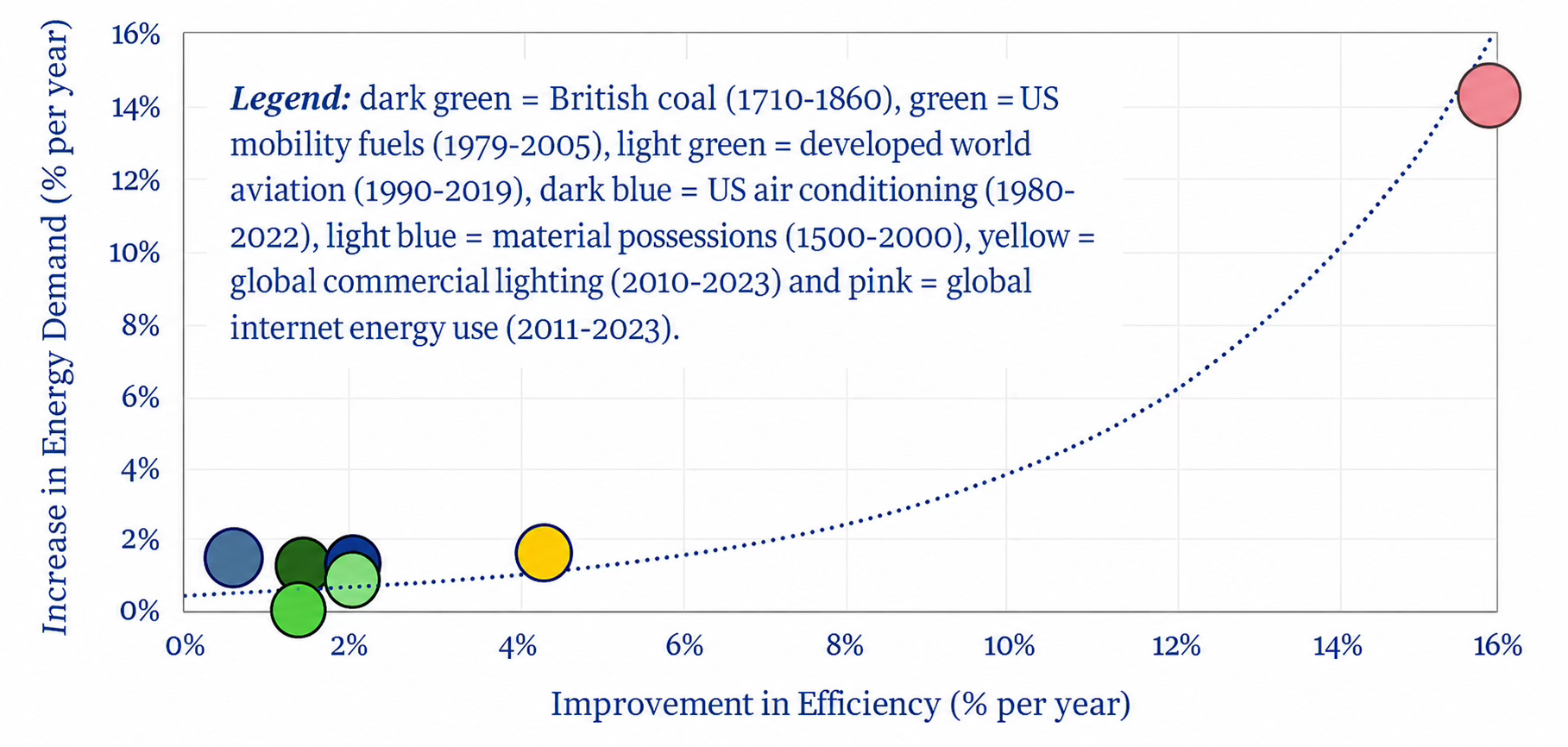
The surge in global internet energy use, highlights how our digital infrastructure has become a primary driver of this trend, far outpacing the efficiency gains of previous technological shifts. Rather than flattening the curve, every marginal gain in optimization seems to serve as a catalyst for further expansion, pushing us further along a path of systemic exhaustion that defies our best intentions for sustainability.
This reliance on efficiency as a saviour is a persistent historical fallacy. While the Jevons Paradox explains how efficiency gains paradoxically drive up the total consumption of abundant resources—like coal—the whale oil industry serves as a grim counterpart. It illustrates what happens when we apply that same obsession to a finite, biological base.
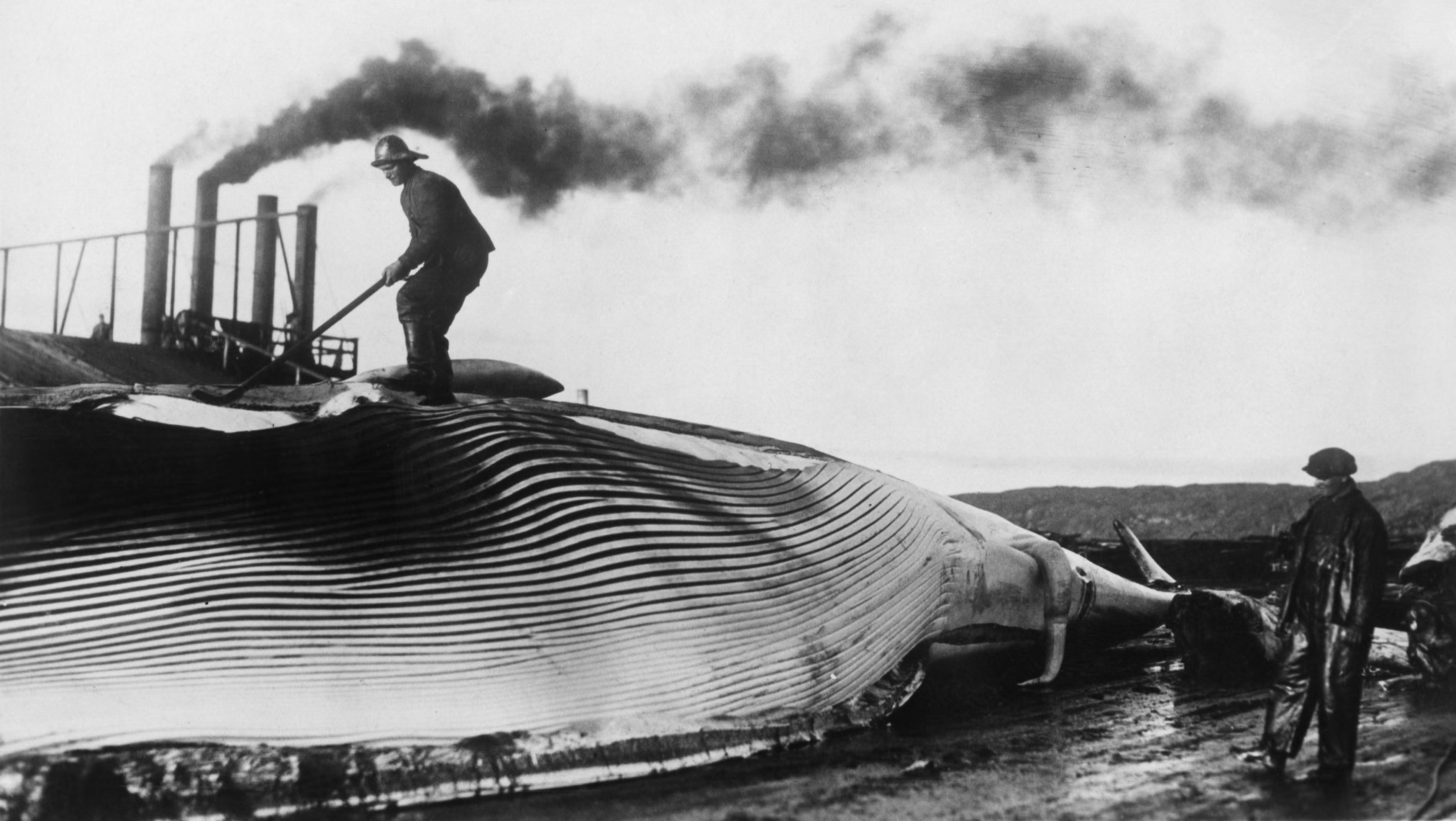
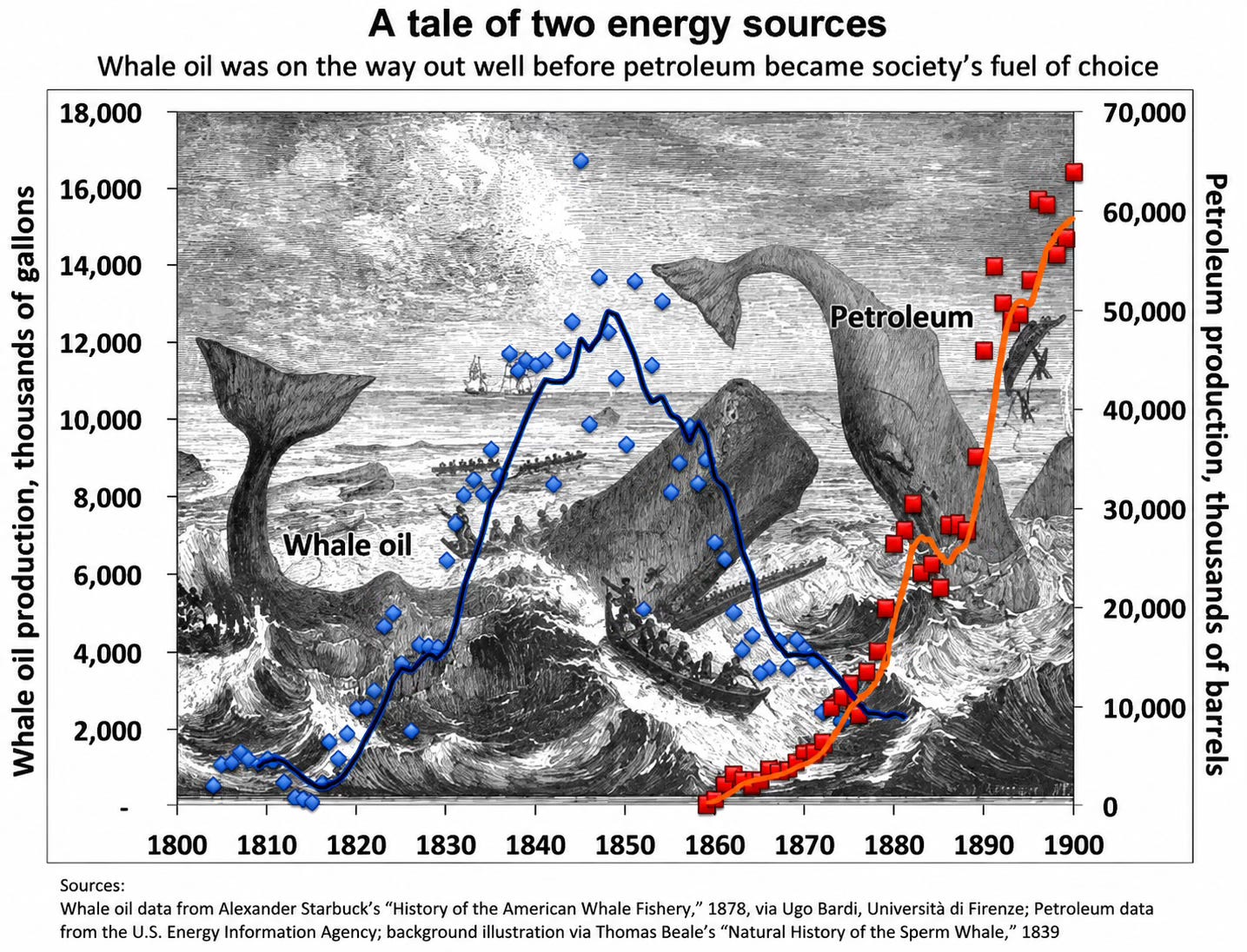
During the eighteenth and nineteenth centuries, the transition from tallow candles to whale oil was driven by the promise of efficiency: whale oil burned brighter, cleaner, and longer, making it the superior fuel for illumination. But this efficiency did not lead to conservation. Instead, as hunting techniques were refined and fleets expanded, the increased accessibility of the resource only fueled demand. We didn't use this surplus to spare the whales; we used it to illuminate and industrialise the world at a massive scale, driving the resource base toward inevitable collapse.
By mid-century, whale oil production had peaked at 12 million gallons per year and plummeted to less than half that by 1860. The industry was so physically exhausted that the future of whaling had become entirely dismal; President Abraham Lincoln eventually ordered 38 decrepit whaling ships to be filled with stone and sunk at the mouth of Charleston harbour to form a stone blockade during the Civil War. Whaling was dying long before kerosene emerged as a saviour, a testament to the fact that our obsession with optimisation is not a path to conservation, but a catalyst for systemic exhaustion.
This brings us to a fundamental question: why, in the face of such clear historical evidence, do we continue to double down on the same destructive strategy? The answer lies in a strange competitive logic that forces us forward, even when the path leads to collapse.
A fitting metaphor comes from Lewis Carroll's 1871 novel Through the Looking-Glass. As the Red Queen drags Alice across the landscape at a breakneck pace, Alice realises they haven’t moved an inch from their starting point. The Queen’s reply provides the definitive rule of this state:
“Here, you see, it takes all the running you can do, to keep in the same place.”
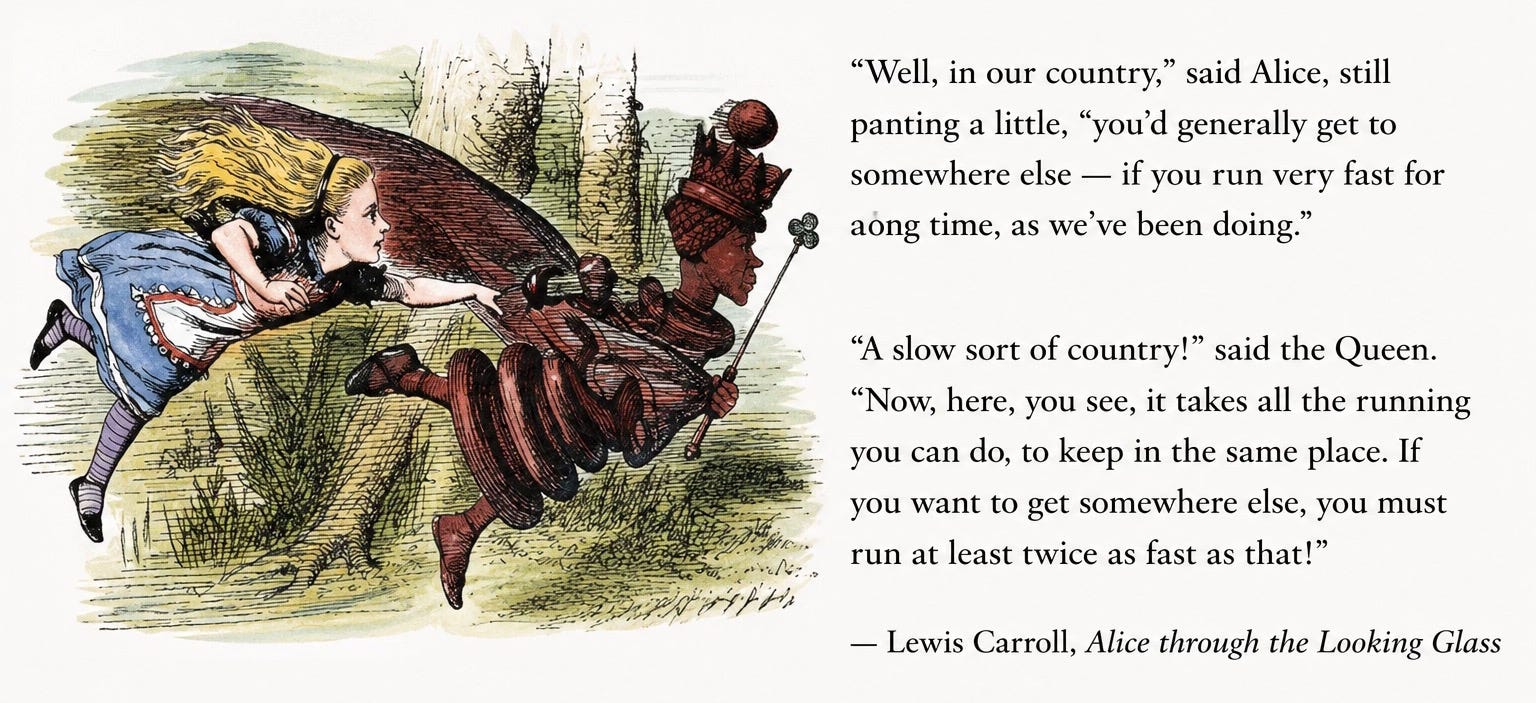
In 1973, biologist Leigh Van Valen applied this metaphor to the fossil record, proposing the Red Queen’s hypothesis to explain why a species’ risk of extinction remains constant regardless of its age. Longevity offers no armour; surviving ten million years grants no reprieve for the next ten. The primary threat is not the environment, but the competition: every leap forward by a rival forces you to sprint merely to maintain your current position.
Nowhere is this phenomenon more visible than in artificial intelligence, where the 'Red Queen's race' has shifted from biological evolution to silicon-based industrial warfare. In 2025, AI startups shattered every previous funding record, attracting an unprecedented $192.7 billion in global venture capital. Like Alice, the world's most powerful tech companies are now forced to run simply to remain where they are—locked in a frantic, energy-intensive race driven by the same competitive logic that once transformed the industrial world.
To survive this sprint, massive capital investments are being funnelled directly into the pursuit for greater efficiency, perfectly illustrated by the launch of Nvidia’s Blackwell architecture. Engineered under Jensen Huang to be among the most energy efficient chip architectures for heavy AI tasks, these chips were initially heralded as a victory for sustainability.

Since the product launched in 2024, the NVIDIA-driven boom in data center construction has fundamentally reshaped the global energy landscape. Yet, just like the Jevons Paradox warns, every leap in efficiency is not leading to a lower energy footprint. By drastically lowering the effective cost of raw compute, these efficiency gains have merely democratised and accelerated its use, sparking an insatiable demand for more data centers and fueling a surge in energy consumption.
This dynamic mirrors the trajectory of the whaling industry. We are applying the same obsession with optimisation to our physical limits—the massive hardware and grid requirements needed to fuel our energy and compute hunger—driving them toward a point of systemic exhaustion. We are not building a more sustainable future; we are financing a high-speed sprint toward collapse, all while running as fast as we can just to stay exactly where we are
Yet, this systemic behaviour is not merely a byproduct of the internal logic of infinite growth, it is deeply rooted in our own anatomy.
Our Red Queen-like drive to sprint is fueled by the prefrontal cortex, the part of our brain responsible for planning and complex problem-solving. We are evolutionarily wired to seek more effective solutions; whenever we find a way to do the same task with less effort, the brain registers it as a success and rewards us, reinforcing the very behaviour that keeps us running.
This biological drive creates a perfect collision with the Jevons paradox. When the 19th-century whaling industry was collapsing from over-extraction, we didn't embrace restraint; we used the efficiency of petroleum-derived kerosene to bypass the limit and accelerate consumption further. We are trapped in a feedback loop where we use the efficiency of one transition to fuel the extraction of the next, proving our neurology is designed not to respect planetary limits, but to innovate our way past them in a relentless pursuit of growth.

This is where our obsession with progress starts to resemble the fate of Icarus.
In the original myth, Daedalus crafted wings of feathers and wax for his son, warning him that the path to freedom required a delicate balance: fly too low, and the sea spray would weigh the wings down; fly too high, and the sun’s heat would melt the wax. But Icarus, intoxicated by the sensation of flight, pushed beyond those limits. He flew too close to the sun, which melted the wax holding his wings together, causing them to disintegrate and sending him plummeting into the sea.
Just as Icarus was seduced by the effortless power of flight, we have become addicted to the height our innovation provides, forgetting that the sun is the same force that will inevitably melt the precarious resources holding our society together.
We have crafted our wings from the wax of technological innovation, and with every advancement, we fly higher, fueled by the intoxicating belief that we can transcend the gravity of our material reality. Yet, we ignore the Jevons paradox, which acts as the heat slowly softening the wax. The more efficient we make our flight, the higher we dare to ascend, bringing us ever closer to the scorching reality of our limits.
We believe we are masters of the sky, yet we remain entirely dependent on the structural integrity of a planet we are systematically dismantling.
Thank you for reading!
If you enjoyed this essay, consider subscribing for free to receive my posts directly in your inbox and support my work!

📨 If you think someone would enjoy this, send it their way!
I, for one, am glad that the scarcity of whale oil led Rockefeller and his ilk to refine petroleum. The world is a much better place than it was in the 19th century and much of that can be contributed to the quest for more abundant energy and its use in machines that make our lives better.