
The Ottoman Playbook
Turkey is rediscovering the power of sitting between worlds.

Earlier this month, President Donald Trump travelled to Ankara for a NATO summit and sat beside a man he has rarely tried to hide his admiration for.
Over the course of more than two decades in power, Recep Tayyip Erdoğan has survived everything politics and geopolitics could throw at him: elections, sanctions, a coup attempt, mass protests, pressure from Washington, pressure from Moscow, and repeated predictions of his political demise. Through it all, he has remained firmly in control. Trump, who has long admired leaders capable of turning political longevity into power, appeared pleased to be back in his company:
“I was very disappointed with NATO. Frankly, if it (the summit) weren’t held in Turkey, where my friend happens to be a very strong leader, a very strong person, it’s possible that I wouldn’t have attended”.
The optics were difficult to misread. Two presidents smiling in Ankara. Two NATO allies presenting themselves as friends. And, at least on the surface, a relationship considerably warmer than much of the alliance surrounding them.
Yet, behind the handshakes, Turkey has made a series of decisions that point toward something far more consequential.
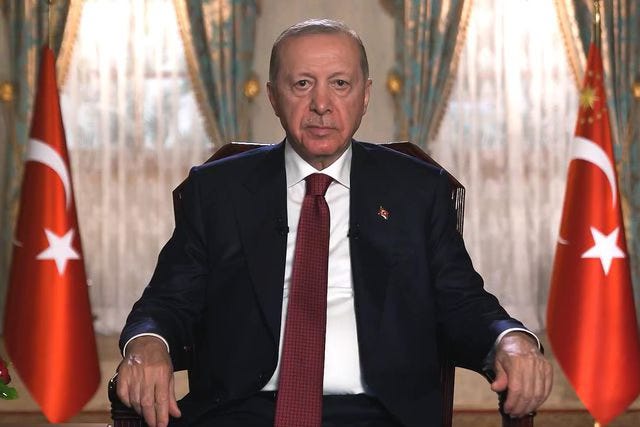
For instance, in May, marking Eid al-Adha, Erdoğan predicted that once the instability surrounding Turkey subsides, the country would emerge as “one of the shining stars of the new era”, invoking the restoration of Ottoman-era influence across the region.
At first glance, it is tempting to dismiss such language as the usual theatre of Turkish politics. Erdoğan has spent much of his career wrapping modern Turkish ambitions in the symbolism of an older empire. But empires, even dead ones, leave behind maps. Turkey happens to sit at the centre of one of the most important.
For centuries, Ottoman power rested not simply on territorial conquest, but on controlling the spaces between other powers. Constantinople connected the Black Sea to the Mediterranean, Anatolia connected Europe with Persia and Central Asia, the Levant opened the road toward Arabia and Egypt, and the Balkans pushed Ottoman influence deep into Europe. Ultimately, the empire sat between worlds, meaning that position mattered more than almost anything it possessed beneath the ground.
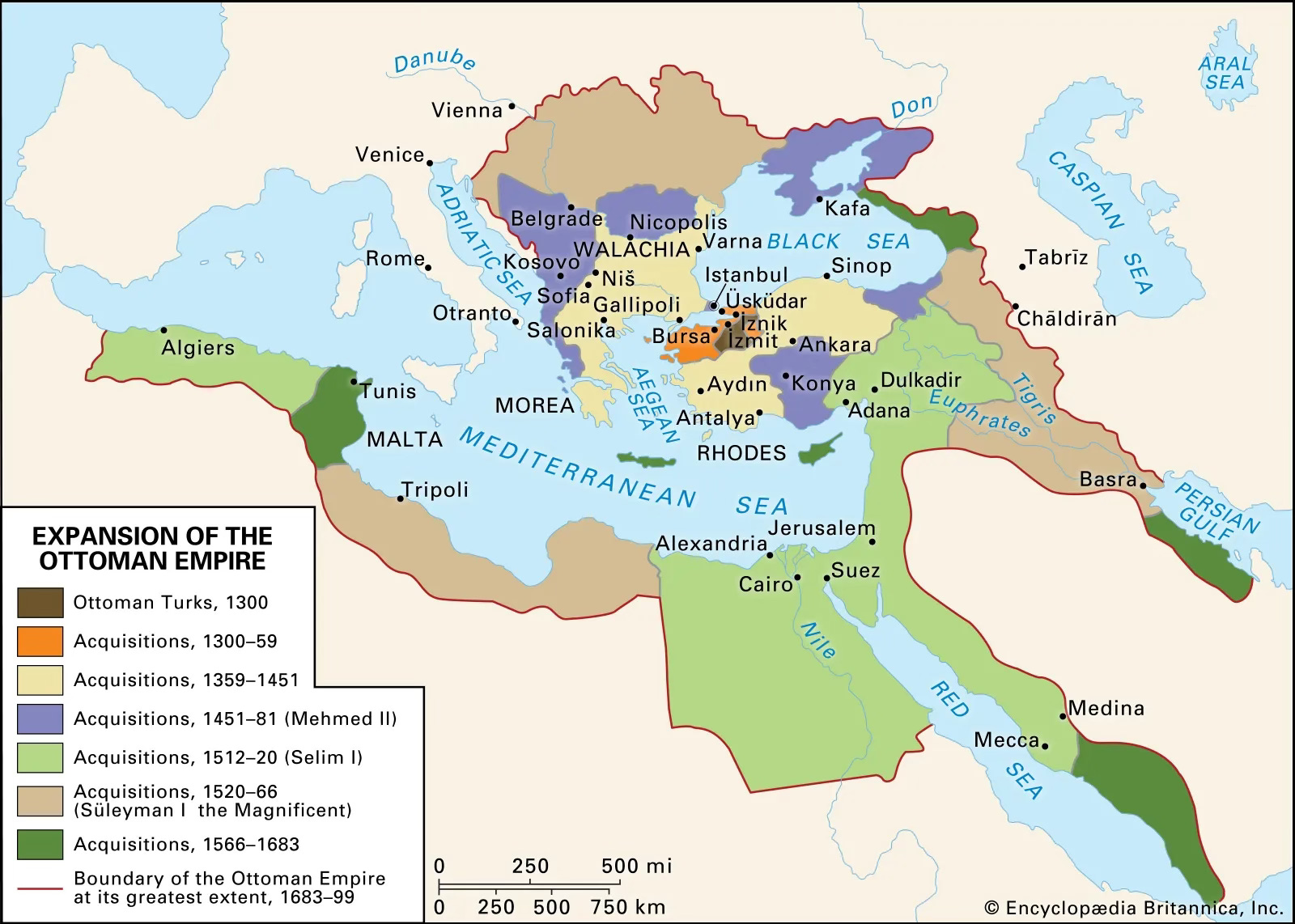
When the Ottoman Empire collapsed after the First World War, the territory disappeared, but the geography remained. The Bosphorus was still there, and so were the Dardanelles. Russia still needed access to warm-water seas, Europe still bordered the Middle East, and trade still moved between Asia and the Mediterranean. The Turkish Republic inherited a fraction of the empire’s territory, but much of its strategic real estate.
During the Cold War, Washington understood this perfectly. Turkey joined NATO in 1952, only three years after the alliance was created. The reason was hardly ideological sentimentality. The Soviet Union sat immediately to Turkey’s north-east, while the Turkish Straits controlled the maritime exit from the Soviet Black Sea Fleet. American nuclear weapons eventually arrived on Turkish soil, and NATO installations followed. Turkey became the southeastern wall of Western containment.
Decades later, it increasingly appears that Erdoğan has concluded that Turkey is worth more when nobody is entirely certain which way it will lean. Indeed, that calculation explains much of what might otherwise appear to be a contradictory Turkish policy.
One particularly telling signal came in March, when Turkey’s reported holdings of US Treasuries collapsed from roughly $16 billion to just $1.8 billion in a single month. There are mundane explanations for such a move. Turkey has spent years defending a weakening lira, rebuilding foreign-exchange reserves, and fighting inflation above 30%. Treasuries are liquid assets, and liquid assets exist partly to be sold during periods of financial stress.
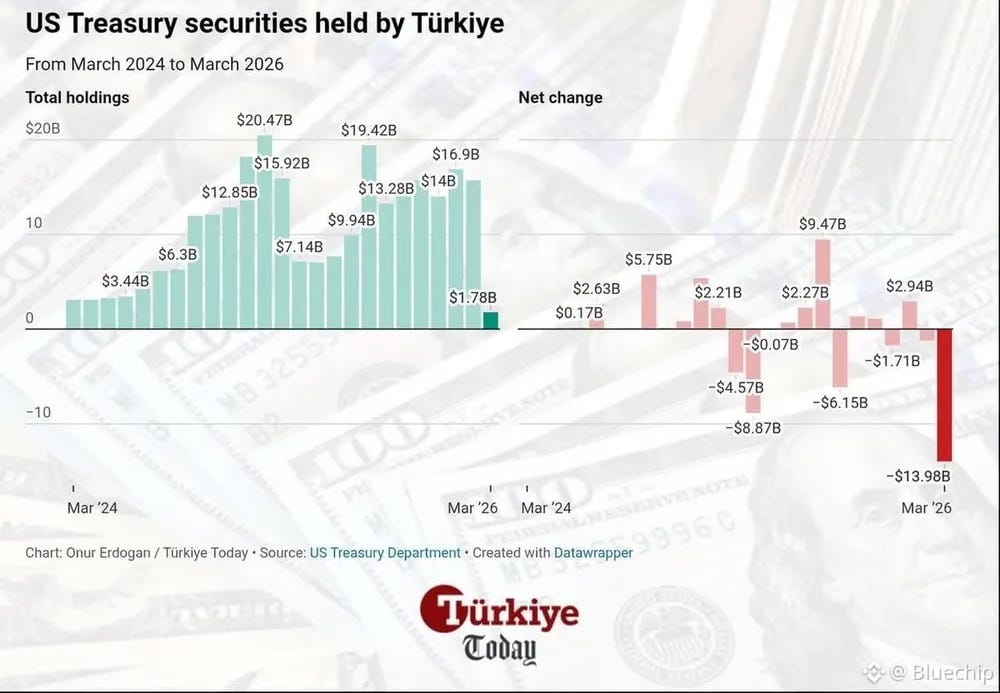
However, that is merely the first-order explanation. The second-order question is what Turkey’s resulting position tells us, especially because the Treasury move does not exist in isolation.
Indeed, at the same time Ankara reduced one form of financial exposure to the United States, it simultaneously deepened a completely different relationship with Russia in the sector where strategic dependency becomes physical: energy.
Russia’s state-owned Rosatom is constructing the Akkuyu nuclear power plant on Turkey’s Mediterranean coast. The plant consists of four reactors that once fully operational, are expected to provide roughly 10% of Turkey’s electricity. Akkuyu is not a normal export project. Under its build-own-operate structure, Rosatom is not merely selling reactors to Turkey and leaving. The Russian company owns the project and will remain deeply embedded in its financing, fuel supply, technical operation, and infrastructure for decades. Moscow recently committed billions more to completing it, with $4-5 billion allocated in 2026 alone.
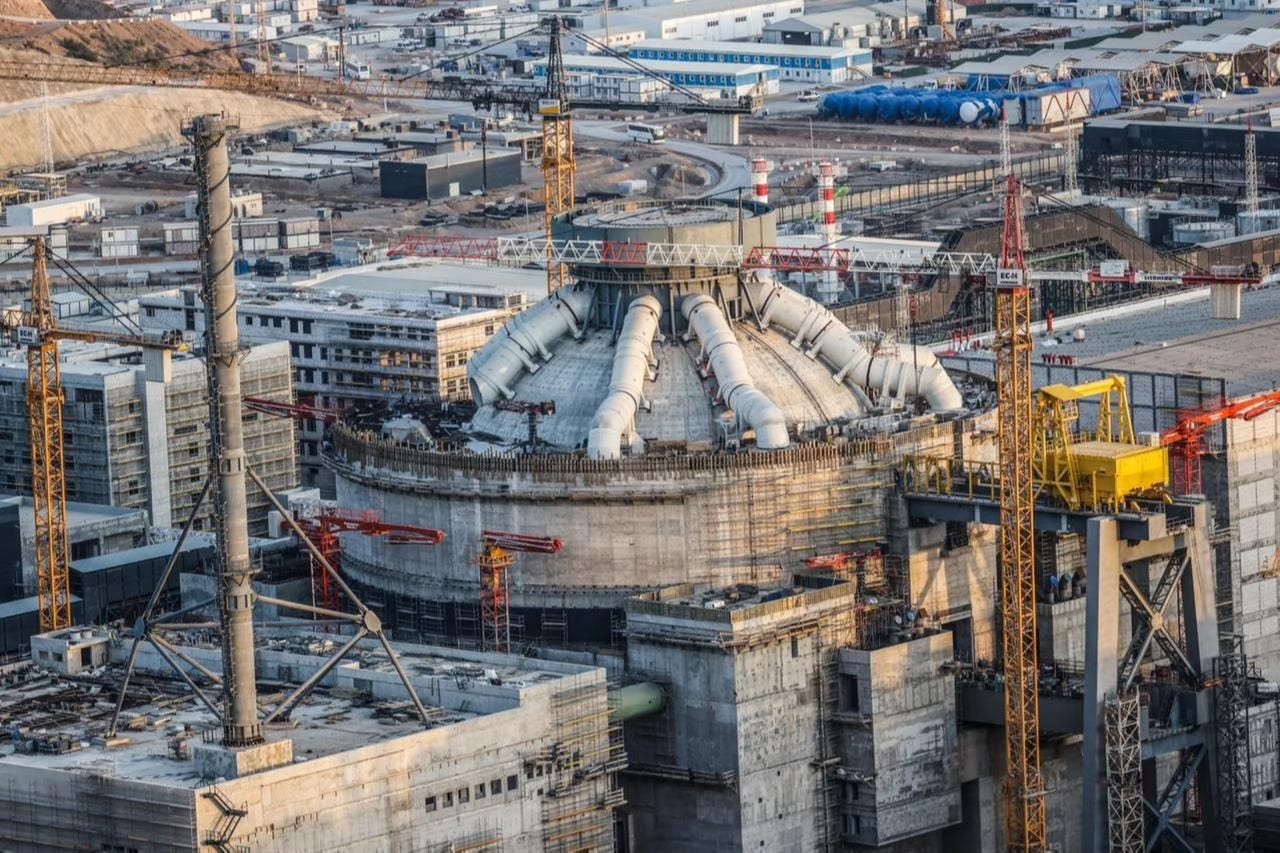
Viewed through the old Cold War map, the arrangement is quite bizarre. Turkey, a NATO member controlling Russia’s access to the Mediterranean, is voluntarily allowing a Russian state-owned company to build and own infrastructure that supplies a significant share of its electricity.
Yet, viewed through Erdoğan’s map, it makes more sense. Turkey is not moving from Washington toward Moscow; instead, it is creating room to manoeuvre between them. A country seeking autonomy makes itself useful to several camps simultaneously, and few countries embody this strategy more clearly than Turkey.
To put this in perspective: Turkey sells drones to Ukraine while buying Russian energy. It closes the Bosphorus to Russian warships (under the Montreux Convention), while refusing to join the Western sanctions regime against Moscow. It competes with Russia in Syria, Libya, and the Caucasus, while allowing Russian capital, tourists, and trade to flow through its economy. It remains a NATO member while purchasing Russian S-400 air defence systems, strongly enough opposed by Washington to get Turkey removed from the F-35 program.
None of these choices align with a conventional East vs. West framework. The reason may be that Ankara largely discarded that framework years ago
Consequently, its strategy is more in line with the Ottoman approach: make yourself necessary to competing systems, and prevent any single system from becoming powerful enough to dictate your choices. For Erdoğan, the disorder spreading across the Middle East may therefore represent less of a threat than an opening.
A clear historical example lies to the south and east: for decades, Iran has been one of the principal constraints on Turkish influence, building an arc of power stretching through Iraq and Syria into Lebanon using proxy networks and the IRGC. In response, Turkey built a competing network by backing factions across the region, cultivating Azerbaijan, deepening ties with Qatar, and promoting itself as a political centre of the Sunni world. The two powers did not need to fight directly, as geography ensured competition. Therefore, if Iranian influence weakens, the consequences will certainly not end with Iran.
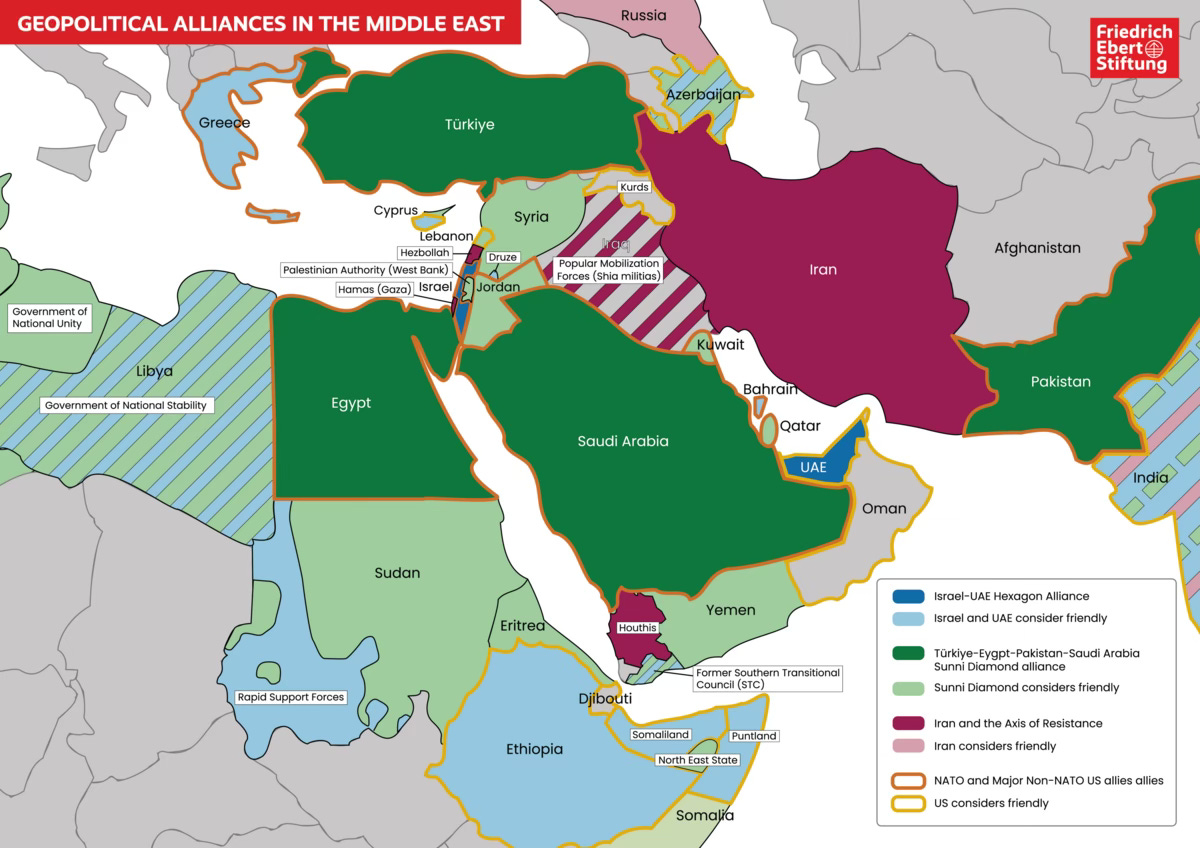
After all, power in international politics is relative. If one power falls faster than another, the other becomes stronger even if nothing about it has changed. This is where Washington and Jerusalem may be creating a problem they have not fully priced in: for Israel, weakening Iran removes its most organised regional network, while for Washington, it potentially lowers the military burden of managing the Middle East.
At first glance, first-order thinking suggests a more favourable regional balance. However, second-order thinking asks the crucial question: who occupies the void Iran leaves behind? The answer sits directly to its northwest.
Syria offers the clearest illustration of this dynamic. For much of the civil war, Turkey, Russia, and Iran were locked in an extraordinary triangular relationship over the country. Today, the weakening of Iranian influence changes that equation, and so does Russia’s preoccupation with Ukraine. As a result, every unit of political and military attention Moscow or Tehran can no longer devote to Syria increases the relative value of the actor already sitting across its northern border with a large army, established supply routes, and years of operational experience.
Yet, Ankara does not need to conquer the region to benefit from its fragmentation; it only needs the other regional powers to become weaker. Naturally, this helps to explain why relations with Israel increasingly matter.
Turkey was the first Muslim-majority country to recognise Israel, doing so in 1949. By the 1990s, the relationship had developed into military cooperation, intelligence links, and defence trade. Israel gained a strategically valuable relationship with a large Muslim NATO state, while Turkey gained technology, Western access, and a useful regional partner.
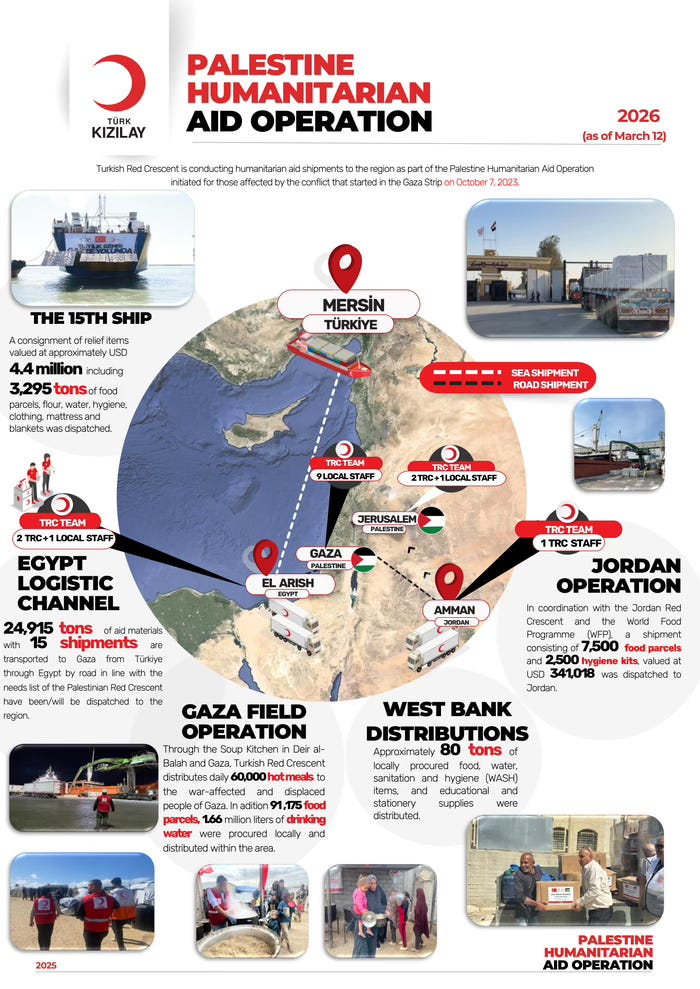
That equilibrium has been eroding for years, and Gaza accelerated its destruction. Rooted in a deep shared history, Palestine and Turkey maintain strong cultural and social connections. Naturally, those ties have repeatedly translated into material support, meaning Ankara has consistently provided humanitarian and development assistance to Palestinians in Gaza through successive periods of conflict.
In recent years, Erdoğan has emerged as one of Israel’s fiercest critics. Speaking before the 79th United Nations General Assembly in New York, he made little effort to temper his language:
“Just as Hitler was stopped by the alliance of humanity 70 years ago, Netanyahu and his murder network must also be stopped by the alliance of humanity.”
Naturally, this dynamic works vice versa, as Israeli politicians increasingly describe Turkey not as an irritating partner, but as a strategic threat. Israeli Minister Miki Zohar has argued that Israel should begin treating Turkey as an “enemy state”, and former prime minister Naftali Bennett has warned of a Turkish threat emerging alongside the Iranian one.
Yet, the real issue isn't whether Turkey and Israel are headed for war, because most likely they are not. Rather, the question is why Israel now speaks of Turkey using the same strategic language once reserved exclusively for Iran. Partly,the answer is that the regional balance has already shifted: a weakened Iran does not leave Israel alone at the top. Instead,it exposes the next layer of competition, and Turkey is a very different competitor.
After all, while Iran’s influence was built largely through proxies and asymmetric warfare, Turkey possesses something much broader: a significant industrial economy, a domestic defence industry, NATO’s second-largest military, control of the Bosphorus, access to the Black Sea, influence in the Caucasus, troops across northern Syria and Iraq, and deep economic connections to Europe.
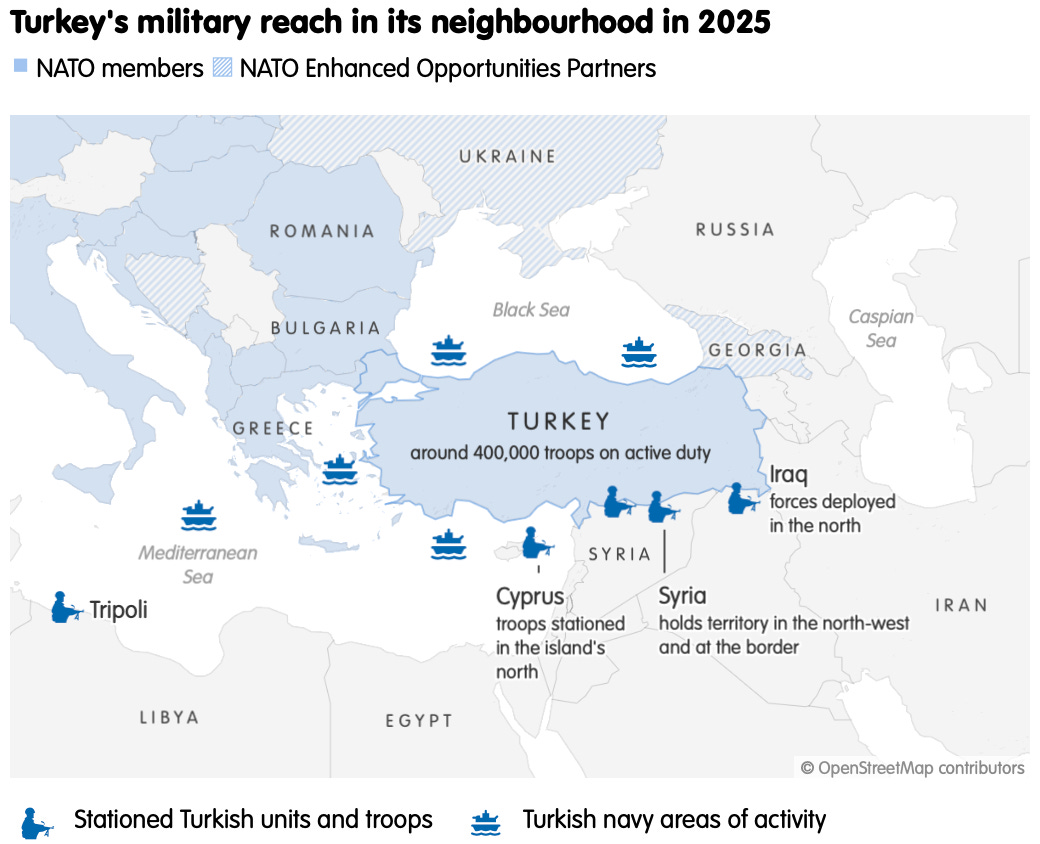
It also possesses something Iran never had: formal membership of the Western security architecture. That makes Turkey difficult to contain without damaging the system containing it.
All of this brings us back to Trump and Erdoğan in Ankara. Indeed, Trump sees Turkey as an asset: a large military, influence in Syria, leverage over Russia, and the ability to shoulder a regional burden Washington would rather leave behind. However, therein lies the paradox: almost everything making Turkey more valuable to Washington is also making it less dependent on Washington. After all, a weaker Iran expands Turkish influence to the south, a distracted Russia increases Ankara’s leverage to the north, while an anxious Europe and the Black Sea conflict make Turkey increasingly indispensable to NATO.
For now, Trump’s desire for stronger regional partners and Erdoğan’s pursuit of greater autonomy overlap. Yet, they may not forever. Ultimately, Erdoğan is not rebuilding the Ottoman Empire; instead, he is rediscovering its strategic logic: sit between Europe, Russia, Asia and the Middle East, become indispensable to competing powers, and dependent on none.
Trump calls Erdoğan a friend, Moscow calls him a partner, Europe calls Turkey indispensable, and Israel increasingly calls it a threat. In the end, Erdoğan may prefer it exactly that way.
Thank you for reading!
If you enjoyed this piece, consider subscribing for free to receive my posts directly in your inbox and support my work.
📨 If you think someone would enjoy this, send it their way!
Let me preempt my comment by saying I am Greek. However I hope, I can keep a realistic viewpoint.
Turkey’s economy is by no means rosy. Their currency has been in free fall for some time. Their economic policy is unorthodox. This in itself is a weakness, not a competitive edge that is not really mentioned in the article (except a simple reference to the inflation level).
I am not going to refer extensively to the level of their democracy and the questionable coup, although it has extended the political life of the president.
NATO and being indispensable…. At the same time allowing the unlawful flow of immigrants (let me not use a more strong wording) even if the country gets economic support from EU for exactly the opposite reason. Threatening Greece (another NATO member) with war…
The US congress has seen this playbook in the past, thus has taken Turkey out of the F35 programme.
More importantly being friendly with many doesn’t mean that you are true friends. As in real life, acquaintances and opportunistic friendships end when situations change.
It’s a volatile period across the globe, so we shall see what happens.
Thank you for this essay! I would love to hear your thoughts about the recent status and the future perspectives of the Regional Four (or R4 Group) in connection with your analysis.