
Wait and Win
As the United States asserts military dominance, China quietly prepares to inherit the aftermath.

Two centuries ago, at the Battle of Austerlitz in 1805, Napoleon Bonaparte orchestrated what remains the gold standard for cold-blooded strategic realism. Facing the combined might of the Russian and Austrian Empires, Napoleon deliberately feigned weakness. He abandoned the dominant Pratzen Heights and thinned his right flank, luring his enemies into an over-ambitious assault that fatally overextended their own lines. As they rushed into the perceived gap, Napoleon unleashed a crushing counter-strike.
“Never interrupt your enemy when he is making a mistake.”

While that famous quote is often attributed to Napoleon Bonaparte, its historical authenticity is debated. Yet, the principle it describes fits the Chinese Grand Strategy perfectly.
In the hallowed halls of the Zhongnanhai, this maxim has been adopted as the silent cornerstone of Chinese Grand Strategy. While the West often measures power through the frequency of its interventions, Beijing measures it through the efficiency of its patience.
Today, China is watching as the United States asserts military dominance across multiple theaters, even as it drifts toward a potential overextension trap where global commitments begin to outpace logistical reality. From the South China Sea to the Persian Gulf, the American superpower is increasingly forced into a series of reactive moves that may ultimately favor Beijing’s long-term vision.
The global order is currently undergoing a violent re-calibration. In the span of just three months, the chessboard upon which Beijing had meticulously placed its pieces has been upended. First, we witnessed the destabilization of Venezuela, where China has sunk over $60 billion in cumulative investments and loans to secure a foothold in the United States' backyard. Now, the Middle East is engulfed in a conflagration that threatens the vital arteries of the People’s Republic.
At first glance, this appears to be a catastrophic sequence of setbacks for Xi Jinping. Two critical partners of the Belt and Road Initiative (BRI) are taking heavy blows. The American military machine is operating at full throttle, and Chinese ambitions seem to be evaporating in the smoke over Tehran.
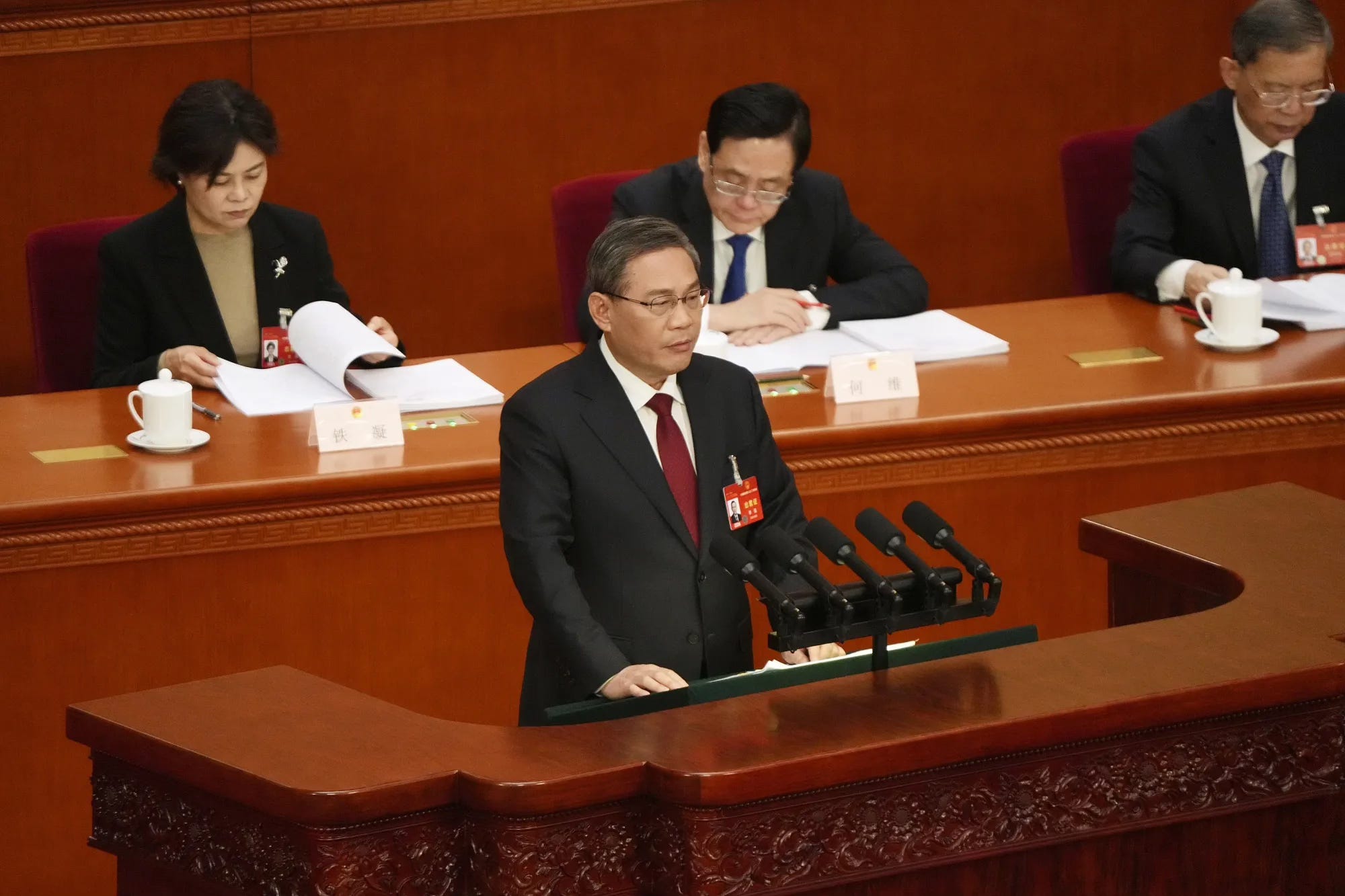
China’s premier Li Qiang acknowledged these disruptions in his speech last week at the National People's Congress (NPC):
‘‘While we acknowledge our achievements, we are also fully aware of the difficulties and challenges we face.
External factors continue to have a significant impact on China.’’
However, analyzing Chinese state logic from a purely strategic and macroeconomic perspective reveals a different pattern. China is not losing influence, it is repositioning itself as the only rational actor in a world of emotional hegemons. While Washington exhausts its munitions and moral capital, Beijing is executing a strategy of calculated passivity that lays the foundation for a hegemony built not on bombs, but on reconstruction and dependency.
To understand the Chinese strategy, one must look at the cold data of energy flows. China is the world’s largest energy importer, and the Gulf region is the beating heart of that supply. While political rhetoric often emphasizes the "unbreakable bond" with Iran, the trade balance tells a more nuanced story.
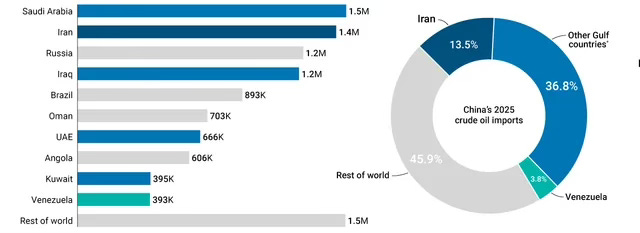
Annual trade between China and the Gulf Cooperation Council (GCC) states totals approximately $250 billion. This is nearly ten times the volume of trade with Iran. For China, Iran is not an equal partner but a strategic instrument. While Iran exports nearly 90% of its crude oil to China, from Beijing’s perspective, Iranian oil accounts for only roughly 13.5% of its total imports. China’s true strategic depth lies with the Gulf states and Russia.
Over the past years, China has built an impressive strategic reserve of approximately 1.5 billion barrels of oil. With domestic consumption—though growing—increasingly offset by renewables and domestic production, this means China can operate with total autonomy for roughly 120 days in the event of a total blockade of the Strait of Hormuz.
These data points explain China’s composure. Where the U.S. feels compelled to intervene to guarantee market stability (thereby depleting its own resources), China can afford to watch for months as the market corrects itself, knowing they are the buyer of last resort who will eventually dictate prices when reconstruction begins.
Like what you’re reading? Subscribe for free to Financial Compass to get new articles delivered straight to your inbox. 📥
A common critique is that China is a so-called "paper tiger" because it fails to defend its partners militarily. This misinterprets the fundamental Chinese doctrine of non-interference. For Beijing, military intervention is a sign of weakness, not strength. It costs capital, destroys infrastructure they intend to exploit later, and creates long-term animosity.
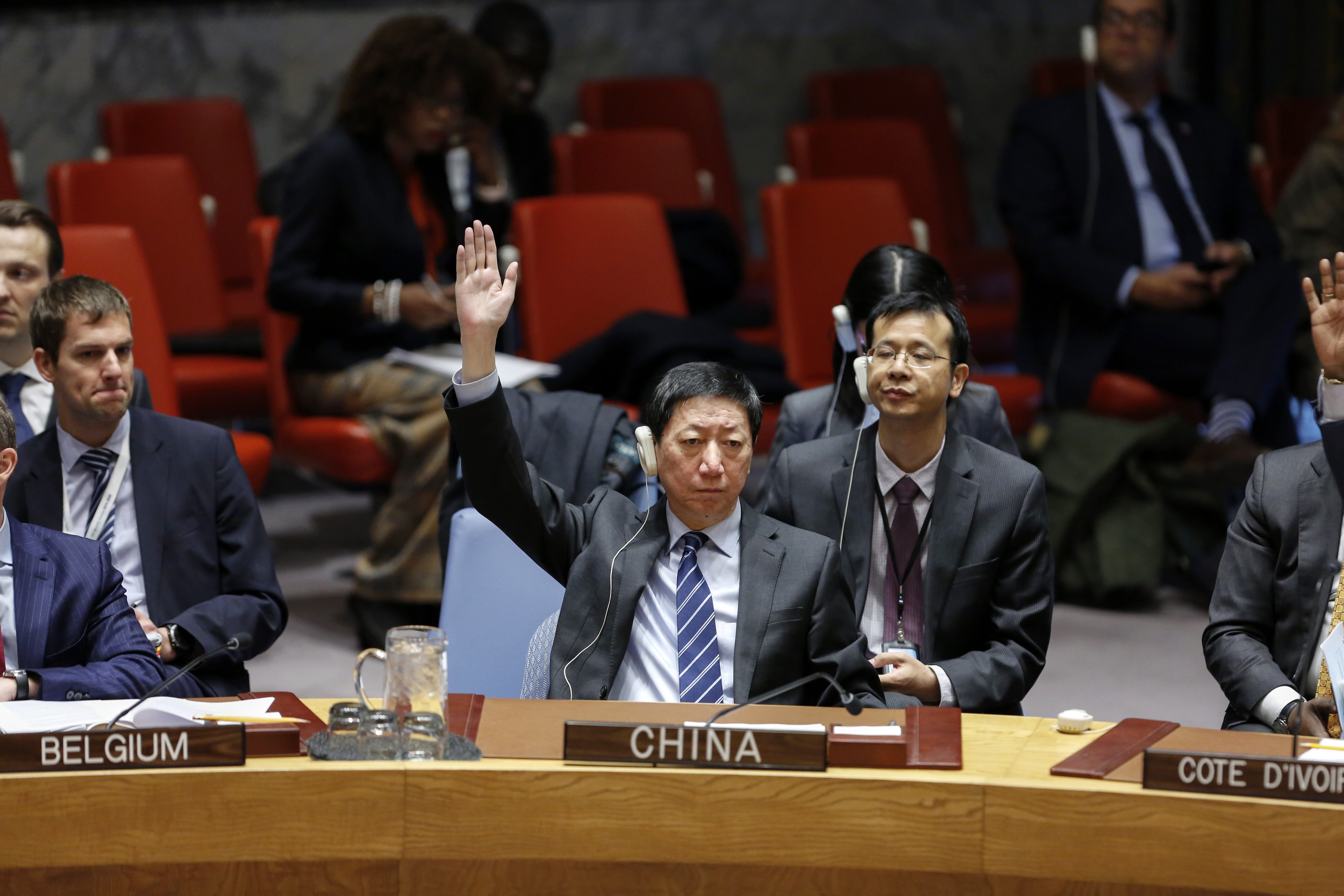
Consider the military footprint: the U.S. maintains hundreds of bases globally, China has only one in Djibouti. This is a deliberate choice. By remaining aloof in the conflict between Iran and the Gulf states, China positions itself as the honest broker. Recently, in the UN Security Council, Russia and China abstained from a resolution condemning Iranian attacks on the Gulf states. This may look like a lack of backbone, but it is pure Realpolitik.
Beijing knows that the Gulf states—despite their current military cooperation with the U.S.—increasingly view America as a source of instability. Every American missile fired to protect an ally reminds that ally they have been dragged into a conflict that is not their own.
China offers an alternative: security through economic integration. When the smoke clears, China will be the only party capable of sitting at the table with both Iran and Saudi Arabia without blood on its hands. The strategy is simple: let the U.S. guarantee regional security at the expense of the American taxpayer, while China reaps the economic dividends of that same security.
The most critical strategic advantage for China lies not in the desert, but in the waters surrounding Taiwan. For military planners in Beijing, the war in the Middle East is a gift for their long-term vision of the Indo-Pacific.
American ammunition stockpiles, particularly Precision Guided Munitions (PGMs) and interceptor missiles like the SM-3 and Patriot systems, are not infinite. Intelligence sources suggest that a prolonged campaign in the Middle East could deplete American stocks in the Indo-Pacific by more than 30% within six months. It has already been reported that the U.S. is being forced to tap into strategic reserves originally earmarked for a potential conflict with China.
This is the core of the Chinese gain. While the U.S. burns billions of dollars of high-end technology in the desert against asymmetric threats, China keeps its arsenal intact. The longer the U.S. remains bogged down in an Iranian war of attrition, the lower the probability that Washington can effectively respond to a Chinese move in the South China Sea or Taiwan.
Xi Jinping does not need to attack Taiwan today, he only needs to wait until American conventional deterrence drops below a critical threshold due to logistical exhaustion. The war in the Middle East acts as a strategic drain on American hegemony.
We described this gradual U.S. demilitarisation in the South China Sea in our previous piece, “Eyes on the Price”, when the departure of the US Navy carrier USS Abraham Lincoln created a temporary carrier gap in the region.
This week added a new layer of tension and uncertainty. The United States began relocating elements of a missile defence system previously stationed in South Korea to the Middle East. At the same time, North Korea launched missiles into the sea as the United States and South Korea conducted joint military exercises.
Strategically, for China, war is merely the preliminary phase of a new contracting cycle. The destruction of Iranian oil infrastructure and the collateral damage in the Gulf states create a massive demand for capital and technical expertise. Western firms, hampered by sanctions or political pressure, will hesitate to invest in a volatile Iran. China, conversely, has no such qualms.
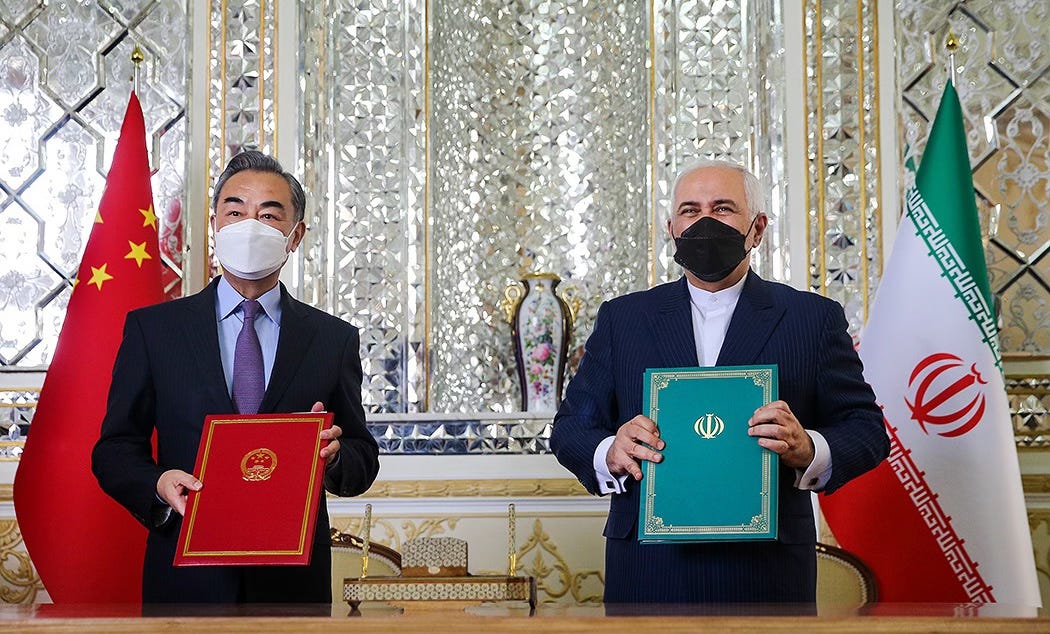
The $400 billon pact with Iran is currently being operationalized in a way that erodes Iranian sovereignty. Because Iran cannot repay loans for reconstruction in hard currency, they are paid in commodities, at prices significantly below market value. This creates a closed economic circuit where China builds the infrastructure, extracts the resources, and assumes political leverage, all without firing a single shot.
We have seen this pattern before. In Africa, China and Russia secured a durable foothold through sustained investment. The same dynamic is visible in countries such as Kazakhstan, home to some of the world’s largest uranium reserves. As described in an earlier piece, “Ground Shifts,” China and Russia quietly locked in access to critical uranium resources through long-term investment and supply agreements, while the United States largely remained on the sidelines.
Furthermore, we are seeing this shift in the Gulf states. Take the Khalifa port project in the UAE, an investment exceeding $60 billion. This project is a blueprint for the future: Chinese technology, Chinese logistics, and Chinese surveillance.
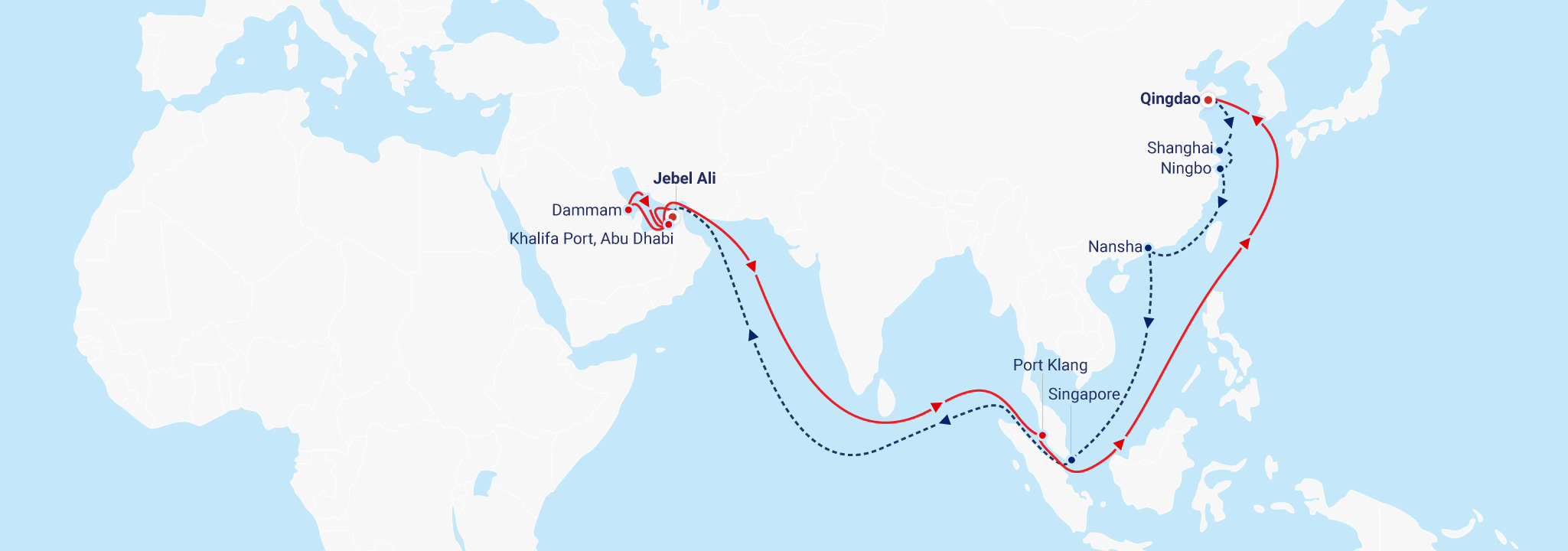
When the Gulf states realize that while the U.S. can defend them, only China can make them grow, the scales will inevitably tip toward Beijing. The rhetoric of the unreliable ally surrounding U.S. foreign policy only accelerates this process.
China’s conduct in this crisis is that of a logical businesspartner who understands that chaos elsewhere creates opportunities for stability at home. By not falling into the trap of intervention, China protects its own economy, exhausts its primary rival, and increases the dependency of its partners.
The data is relentless: while U.S. military spending explodes, China is consolidating its position as the primary trading partner of both the aggressor and the victim in every conflict. Real power in 2026 does not reside with the one who fires the missiles, but with the one who provides the loans to repair the damage. China is not losing partners in the Middle East, it is transforming them from allies into clients. And in Xi Jinping’s world, a client deeply in debt is far more loyal than an ally who only exists on paper.
There is no doubt that the United States has demonstrated overwhelming military dominance across the globe. Yet the question remains whether that dominance can be sustained over the long term.
Beijing wins by waiting, and it is waiting patiently. The rest of the world is too busy fighting to notice that the prize may already have been claimed.
Share this with anyone if you think their attention span can survive more than two paragraphs — and if not, send it anyway. 📨
I'm not a "China hand" but as someone familiar with everyday Chinese people, economic warfare is more their style. Western minds cannot comprehend...
Brilliant essay. I see this kind of active waiting as rooted in Taoism. My post on this is here:
https://wvhaugen.substack.com/publish/posts/detail/191093676?referrer=%2Fpublish%2Fposts%2Fpublished